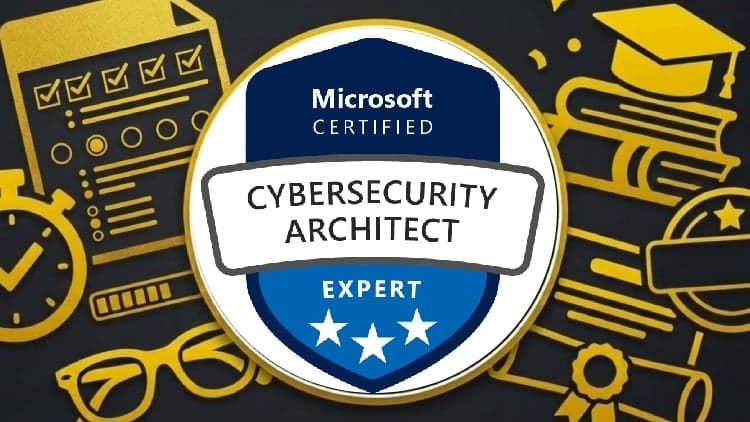
1500 Questions | MS Cybersecurity Architect Expert (SC-100)
Master new skills with expert-led instruction. Get 100% OFF with verified coupons and earn your certificate.
Lifetime access • Certificate included
This course includes:
- 📹0 mins on-demand video
- 📄0 articles
- 📥0 downloadable resources
- 📱Access on mobile and TV
- 🏆Certificate of completion
- ♾️Full lifetime access
📖About This Course
Detailed Exam Domain CoverageTo pass the SC-100 exam on your first attempt, you need a deep, practical understanding of how Microsoft security technologies integrate. This practice test bundle mirrors the exact breakdown of the official exam objectives:Cybersecurity Architecture and Engineering (27%): Designing zero-trust landing zones, secure application architectures on Azure, hybrid network security topologies, and advanced authentication/access strategies.Cybersecurity and Infrastructure Protection (25%): Designing threat intelligence programs, implementing enterprise-wide incident response blueprints with Microsoft Sentinel, and mapping security compliance architectures.Asset Security (19%): Data classification schemas, information protection life cycle management, and aligning asset risk management with broader corporate goals.Security Operations and Incident Response (15%): Architecture for disaster recovery, business continuity planning, vulnerability management cycles, and securing the system development life cycle (SDLC).Governing and Managing Risk (14%): Developing risk management frameworks, regulatory compliance alignment, and setting enterprise information security policies.Course DescriptionEarning the Microsoft Certified: Cybersecurity Architect Expert credential requires more than just memorizing definitions. The SC-100 exam evaluates your ability to translate complex business requirements into secure, resilient cloud and hybrid architectures. I designed this comprehensive question bank of 1,500 original practice questions to bridge the gap between theoretical knowledge and the sharp analytical thinking needed on exam day.Every question in this simulator reflects the style, complexity, and strategic depth of the actual Microsoft exam. Rather than giving you simple true-or-false scenarios, these questions present complex technical problems where you must evaluate multiple valid Azure configurations to choose the absolute best architectural solution. I provide comprehensive explanations for every single option, transforming each question into a mini-lesson that clarifies exactly why a specific setting is architecturally sound and why alternative configurations fail to meet enterprise security standards.Practice Questions PreviewHere is a look at the style, depth, and layout of the questions you will find inside the course:Question 1An organization wants to implement a Zero Trust architecture for a multi-tier web application hosted on Azure. The security requirements mandate that the web tier must not communicate directly with the database tier, all traffic between tiers must be inspected, and dynamic routing changes must be minimized. Which architectural component best satisfies these requirements?A. Use Azure Application Gateway with Web Application Firewall (WAF) enabled in front of the database tier.B. Implement Azure Firewall Premium in a hub-and-spoke topology and route inter-tier traffic using User-Defined Routes (UDRs).C. Deploy Network Security Groups (NSGs) with service tags directly on the database subnet to block web subnet IPs.D. Utilize Azure Front Door with custom routing rules applied directly to internal backend subnets.E. Configure Azure Bastion hosts within the database subnet to proxy incoming application tier requests.F. Implement Azure Private Link with private endpoints configured on the web tier virtual network.Answer and ExplanationCorrect Answer: BExplanation:Why Option B is correct: Azure Firewall Premium provides advanced threat protection and deep packet inspection. By placing it in a hub-and-spoke topology and forcing traffic between the web and database subnets through the firewall via User-Defined Routes (UDRs), you ensure all inter-tier traffic is inspected and controlled without relying on complex, dynamic application-level configurations.Why Option A is incorrect: Azure Application Gateway with WAF is designed to protect HTTP/HTTPS web applications facing the internet or public tiers. It is not an appropriate architectural control for inspecting internal, non-HTTP database traffic (like TDS protocol for SQL Server).Why Option C is incorrect: NSGs filter traffic based on IP addresses, ports, and protocols, but they do not perform deep packet inspection of the traffic content, failing the core requirement to inspect all traffic.Why Option D is incorrect: Azure Front Door is a global, public load balancer and content delivery network. It cannot be deployed entirely internally to route and inspect traffic between isolated backend private subnets within an Azure VNet.Why Option E is incorrect: Azure Bastion is explicitly designed to provide secure administrative RDP/SSH access to virtual machines. It is not an architecture component used to route application-to-database production traffic.Why Option F is incorrect: While Private Link secures access to PaaS services, simply implementing a private endpoint on the web tier does not provide traffic inspection capabilities between application tiers on its own.Question 2You are designing an incident response strategy using Microsoft Sentinel for an enterprise with strict compliance requirements. The design must ensure that security alerts from a critical custom on-premises accounting application are ingested into Sentinel, trigger automated remediation playbooks, and retain log data for a minimum of 7 years while optimizing storage costs. Which design choice satisfies these requirements?A. Stream logs to a standard Azure Storage Account and use an Azure Function to query the logs daily from Sentinel.B. Ingest logs via the Log Analytics agent to a Workspace, configure an automation rule with a Logic App playbook, and set the workspace data retention to 2,555 days.C. Ingest logs via the Microsoft Sentinel Log Ingestion API into a Log Analytics workspace, associate an automation rule with a Logic App, and use Log Analytics data export to Azure Storage Archive tier.D. Configure a Syslog collector VM to forward data to Sentinel, use local cron jobs for remediation, and configure Microsoft Defender for Cloud long-term retention.E. Deploy an Azure Event Hub to collect application logs, stream them to Azure Monitor Logs, and use Azure Backup to retain the workspace data for 7 years.F. Ingest logs as Basic Logs in a Log Analytics workspace, link them to Sentinel analytics rules, and use an Azure Automation runbook for archiving.Answer and ExplanationCorrect Answer: CExplanation:Why Option C is correct: The Log Ingestion API allows custom application logs to stream cleanly into Sentinel. Logic Apps integrated via automation rules satisfy the automated remediation requirement. Exporting the workspace data to an Azure Storage Account with the Archive tier enabled allows the organization to meet the 7-year retention rule while minimizing cost, as native Log Analytics interactive retention becomes expensive over long timelines.Why Option A is incorrect: Sentinel cannot natively perform real-time security analytics or trigger automated incident response playbooks on cold logs sitting in a standard storage account queried by a basic scheduled Azure Function.Why Option B is incorrect: While keeping logs in the Log Analytics workspace for 7 years (2,555 days) is technically possible, it is highly cost-inefficient compared to archiving older data to Azure Storage Archive tier.Why Option D is incorrect: Local cron jobs on a collector VM do not leverage Microsoft Sentinel's orchestration capabilities (SOAR). Additionally, Microsoft Defender for Cloud long-term retention policies do not govern custom app logs stored in Sentinel.Why Option E is incorrect: Azure Backup is used for backing up virtual machines, SQL databases, and file shares; it is not the architectural tool used to manage lifecycle retention or archiving schemas for Log Analytics workspace tables.Why Option F is incorrect: Basic Logs are intended for high-volume, low-value verbose logs. They have limited query capabilities and cannot be used with standard Microsoft Sentinel scheduled analytics rules to trigger incidents.Question 3An architect needs to design a data protection strategy for sensitive files stored across Azure DevOps, OneDrive for Business, and Azure SQL databases. The strategy must enforce classification labels automatically based on content detection, encrypt files at rest, and prevent unauthorized external sharing even if files are downloaded to unmanaged devices. Which combination of Microsoft Purview and Microsoft Defender capabilities should be integrated?A. Implement Azure Storage service-side encryption paired exclusively with Microsoft Defender for Cloud Apps session policies.B. Configure Microsoft Purview Information Protection sensitivity labels with auto-labeling policies, and integrate them with Microsoft Defender for Cloud Apps to monitor and enforce file-level actions.C. Create Purview Data Loss Prevention (DLP) rules combined with Azure SQL Always Encrypted configurations applied to OneDrive folders.D. Configure Conditional Access App Control in Microsoft Entra ID alongside Microsoft Defender for Endpoint data classification.E. Deploy Microsoft Purview Data Map classifiers linked with Azure Key Vault managed keys across all user endpoints.F. Use Microsoft Defender for Identity policies synced with local Active Directory Rights Management Services (AD RMS).Answer and ExplanationCorrect Answer: BExplanation:Why Option B is correct: Microsoft Purview Information Protection sensitivity labels provide the core mechanism for automatic content-based data classification and file-level encryption (via Rights Management). Integrating these labels with Microsoft Defender for Cloud Apps allows you to detect sensitive files across cloud apps like OneDrive and enforce real-time restrictions, preventing unauthorized external sharing even on unmanaged devices.Why Option A is incorrect: Storage service-side encryption only protects data at rest within Azure data centers; it does not persist encryption or classification markings once a file is downloaded to a user's device.Why Option C is incorrect: Always Encrypted is a feature specific to Azure SQL Database to secure columns at rest and in transit from database administrators. It cannot be applied to unstructured files in OneDrive or code repositories in Azure DevOps.Why Option D is incorrect: While Conditional Access App Control can restrict downloads on unmanaged devices, it does not provide the persistent, content-aware document encryption and classification required for downloading files securely.Why Option E is incorrect: The Purview Data Map is primarily used for cloud data estate governance and metadata cataloging; it does not handle real-time endpoint user file encryption or application-level sharing controls.Why Option F is incorrect: Defender for Identity monitors active directory signals and user behavior to detect compromised credentials. It does not inspect file contents, classify data, or manage OneDrive/DevOps sharing mechanics.Welcome to the Mock Exam Practice Tests Academy to help you prepare for your Microsoft Certified: Cybersecurity Architect Expert (SC-100) certification.You can retake the exams as many times as you wantThis is a huge original question bankYou get support from instructors if you have questionsEach question has a detailed explanationMobile-compatible with the Udemy appI hope that by now you're convinced! And there are a lot more questions inside the course.
1500 Questions | MS Cybersecurity Architect Expert (SC-100) - Free Udemy Course [100% Off]
Limited-Time Offer: This IT Certifications Udemy course is now available completely free with our exclusive 100% discount coupon code. Originally priced at $34.99, you can enroll at zero cost and gain lifetime access to professional training. Don't miss this opportunity to master cloud security architectures without spending a dime!
What You'll Learn in This Free Udemy Course
This comprehensive free online course on Udemy covers everything you need to become proficient in Microsoft cybersecurity architectures. Whether you're a beginner or looking to advance your skills, this free Udemy course with certificate provides hands-on training and practical knowledge you can apply immediately.
- Master Zero Trust architecture design using Azure Landing Zones and hybrid security topologies
- Deploy enterprise threat intelligence programs with Microsoft Sentinel
- Implement secure application architectures on Azure with service tag NSGs
- Configure incident response blueprints for compliance-heavy environments
- Design asset risk management frameworks aligned with regulatory requirements
Who Should Enroll in This Free Udemy Course?
This free certification course is perfect for anyone looking to break into cybersecurity or enhance their existing skills. Here's who will benefit most from this no-cost training opportunity:
- IT professionals pursuing Microsoft certification with proven exam preparation
- Cloud architects aiming to specialize in Azure security solutions
- Security engineers transitioning to DevOps-focused roles
- Students building portfolios for cybersecurity job applications
- Professionals seeking free Udemy courses with certification for career growth
- Entry-level candidates preparing for enterprise security roles
- Tech enthusiasts mastering hybrid network security topologies
- Teams implementing enterprise-wide compliance architectures
Meet Your Instructor
Learn from Mock Exam Practice Test Academy, an experienced test-prep specialist in cybersecurity certifications. With a proven track record of helping thousands pass Azure exams, their structured question banks simulate real-world architectural challenges. Industry veterans vouched for their strategic, problem-solving focused curriculum that transforms theoretical knowledge into job-ready skills.
Course Details & What Makes This Free Udemy Course Special
With a 0 rating and 7 students already enrolled, this Udemy free course demonstrates proven value. While new, the course leverages real exam domain coverage across six key areas. A unique feature is the 1,500 question bank with layered solutions, designed to develop analytical thinking through complex technical scenarios. Students gain practical knowledge while learning Microsoft's service ecosystem—from Azure Sentinel monitoring to enterprise risk frameworks.
How to Get This Udemy Course for Free (100% Off)
Follow these simple steps to claim your free enrollment:
- Click the enrollment link to visit the Udemy course page
- Apply the coupon code: 842B349926B9DD91759D at checkout
- The price will drop from $34.99 to $0.00 (100% discount)
- Complete your purchase before the offer expires
- Start learning immediately with lifetime access
⚠️ Note: This free Udemy coupon expires on [date]. The course will return to its regular price after this date, so enroll now while it's zero cost. This is a legitimate, working coupon—no credit card required, no hidden fees, no trial periods. Once enrolled, the course is yours forever.
Why You Should Grab This Free Udemy Course Today
Here's why this free certification course is an opportunity you can't afford to miss:
- Three-question strategy: Start with sample questions to validate effectiveness
- Cost advantage: Benefit from enterprise-grade training at zero cost
- Career boost: Stand out with Microsoft's elite cybersecurity certification
- Time-sensitive offer: Save 100% before this deal resumes regular pricing
Frequently Asked Questions About This Free Udemy Course
Is this Udemy course really 100% free?
Absolutely!
How long do I have to enroll with the free coupon?
This limited-time offer expires on [date]. After this date, the course returns to its regular $34.99 price. We highly recommend enrolling immediately to secure your free access.
Will I receive a certificate for this free Udemy course?
Yes! Upon completing all course requirements, you'll receive an official Udemy certificate. Share it on LinkedIn and your resume to showcase this elite cybersecurity qualification to employers.
Can I access this course on my phone or tablet?
Yes!
How long do I have access to this free course?
Once you enroll with the free coupon, you get lifetime access. There's no time limit—learn at your own pace, revisit lessons anytime, and get future updates at no charge.
Frequently Asked Questions
Q: Is this course really free?
Yes! Using our verified coupon code, you can enroll for 100% OFF. No hidden charges.
Q: Do I get a certificate?
Upon completion of all video lectures, Udemy will issue a certificate of completion.
Q: How long is my access?
Once you enroll with the coupon, you get full lifetime access to the materials.
You May Also Like
LPIC-1 102-500 Practice Tests: 200 Questions Explained
LPIC-1 Exam 101-500 Practice Tests: 200 Questions Explained