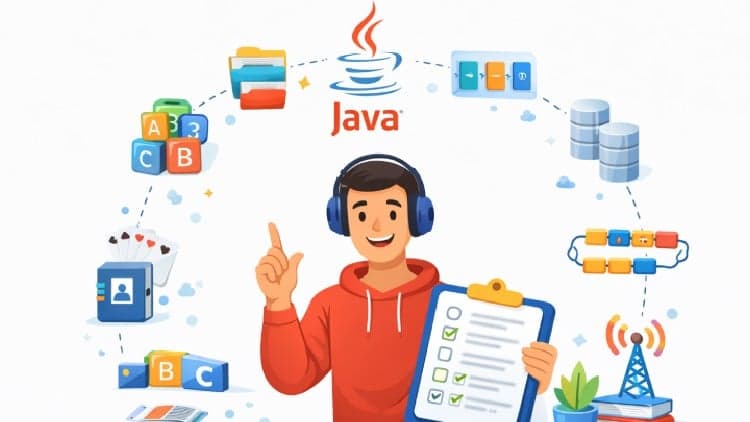
400 Java Collections Interview Questions with Answers 2026
Master new skills with expert-led instruction. Get 100% OFF with verified coupons and earn your certificate.
Lifetime access • Certificate included
This course includes:
- 📹0 mins on-demand video
- 📄0 articles
- 📥0 downloadable resources
- 📱Access on mobile and TV
- 🏆Certificate of completion
- ♾️Full lifetime access
📖About This Course
Master Java Collections with Realistic Practice Exams and Detailed Explanations.Java Collections Framework (JCF) mastery is the definitive line between a junior coder and a high-performing engineer, and I have designed this course to bridge that gap by focusing on the deep architectural "why" behind every data structure. I’ve noticed that most developers can use an ArrayList, but few can explain the threshold where a HashMap switches to a Red-Black Tree or how to prevent memory leaks using WeakHashMap, so I built this question bank to challenge your understanding of Big O complexity, concurrency under the java.util.concurrent package, and modern functional integrations from Java 8 through 21. Whether you are prepping for a grueling senior-level interview or a professional certification, you will find that I’ve focused on real-world scenarios—like choosing the right BlockingQueue for a producer-consumer problem or optimizing initial capacities to minimize GC overhead—ensuring you don't just memorize syntax, but actually learn to engineer high-performance, thread-safe Java applications.Exam Domains & Sample TopicsHierarchy & Architecture: Selection logic for List, Set, Map, and Queue based on performance contracts.Concurrency & Thread Safety: Internals of ConcurrentHashMap, CopyOnWriteArrayList, and Fail-Safe vs. Fail-Fast iterators.Internal Mechanics: Hashing algorithms, collision resolution, and memory footprint tuning.Sorting & Streams: Comparable vs. Comparator and advanced Collectors API integration.Best Practices: Immutability, Collections.unmodifiable, and avoiding memory leaks in caching.Sample Practice QuestionsWhich of the following statements accurately describes the internal behavior of a HashMap in Java 8 and later when a hash collision occurs?A) It uses a secondary hashing function to find the next available slot in the array.B) It immediately throws a ConcurrentModificationException if two keys have the same hash.C) It stores entries in a linked list, but converts the bucket to a Balanced Tree (Red-Black Tree) if the bin count exceeds a specific threshold.D) It uses a SkipList structure to maintain O(logn) access time for all entries regardless of the hash.E) It expands the load factor dynamically without changing the underlying data structure.F) It replaces the existing value with the new one to prevent memory overhead.Correct Answer: COverall Explanation: In modern Java, HashMap optimizes performance during high collisions by "treeifying" buckets. When a bucket reaches a threshold (8 nodes), it converts from a linked list to a Red-Black Tree to improve worst-case lookup from O(n) to O(logn).Option A Incorrect: This describes Open Addressing, which Java's HashMap (using Chaining) does not use.Option B Incorrect: This exception is related to structural modifications during iteration, not hash collisions.Option C Correct: This accurately describes the transition from Node to TreeNode.Option D Incorrect: ConcurrentSkipListMap uses skip lists, not HashMap.Option E Incorrect: The load factor is a fixed measure for resizing the entire table, not a solution for individual bucket collisions.Option F Incorrect: This only happens if the keys are equal (.equals()), not just because a collision occurred.You need to share a list across multiple threads where reads are extremely frequent, but writes are rare. Which implementation provides the best thread-safe performance?A) VectorB) Collections.synchronizedList(new ArrayList<>())C) CopyOnWriteArrayListD) ConcurrentLinkedQueueE) StackF) ArrayBlockingQueueCorrect Answer: COverall Explanation: CopyOnWriteArrayList is designed for scenarios where "read" operations vastly outnumber "write" operations. It creates a fresh copy of the underlying array upon any mutation, allowing readers to access the old array without locks.Option A Incorrect: Vector uses coarse-grained synchronization on every method, which is slow for concurrent reads.Option B Incorrect: This wraps the list in a synchronized block, causing thread contention even for simple reads.Option C Correct: This is the most efficient for "read-heavy" scenarios as it eliminates locking for read operations.Option D Incorrect: This is a Queue, not a List, and follows different access patterns.Option E Incorrect: Stack is legacy, synchronized, and follows LIFO, which isn't the requirement here.Option F Incorrect: This is a bounded blocking queue used primarily for producer-consumer patterns, not general list access.Which Map implementation should I use if I require keys to be sorted according to their natural ordering and need to perform "range queries" (e.g., finding all keys between 'A' and 'F')?A) HashMapB) LinkedHashMapC) TreeMapD) HashtableE) WeakHashMapF) IdentityHashMapCorrect Answer: COverall Explanation: TreeMap implements the NavigableMap interface, which provides methods like subMap(), headMap(), and tailMap() for range-based operations, while maintaining keys in a sorted tree structure.Option A Incorrect: HashMap provides no guarantee on the order of keys.Option B Incorrect: LinkedHashMap maintains insertion order (or access order), not natural/sorted order.Option C Correct: It is the standard implementation for sorted maps and range-based navigation.Option D Incorrect: Hashtable is an unsorted, legacy synchronized collection.Option E Incorrect: This is used for memory management/caching and does not sort keys.Option F Incorrect: This uses reference equality (==) instead of .equals() and does not sort keys.Welcome to the best practice exams to help you prepare for your Java Collections Framework (JCF) Mastery.You can retake the exams as many times as you wantThis is a huge original question bankYou get support from instructors if you have questionsEach question has a detailed explanationMobile-compatible with the Udemy app30-day money-back guarantee if you're not satisfiedI hope that by now you're convinced! And there are a lot more questions inside the course. Enroll today and take the final step toward getting certified!
400 Java Collections Interview Questions - Free Udemy Course [100% Off Coupon]
Limited-Time Offer: This Programming Languages Udemy course is now available completely free with our exclusive 100% discount coupon code. Originally priced at $109.99, you can enroll at zero cost and gain lifetime access to professional training. Don't miss this opportunity to master Java Collections Framework without spending a dime!
What You'll Learn in This Free Udemy Course
This comprehensive free online course on Udemy covers everything you need to become proficient in Java Collections Framework. Whether you're a beginner or looking to advance your skills, this free Udemy course with certificate provides hands-on training and practical knowledge you can apply immediately.
- Master Java Collections Framework to dominate tech interviews and programming challenges
- Understand advanced data structures like HashMap, TreeMap, and ConcurrentHashMap implementations
- Implement thread-safe data structures for high-performance Java applications
- Optimize application performance using B-tree optimizations and memory management techniques
- Implement Java 8+ Streams API and functional programming integrations with collections
- Prepare for senior-level interviews using production-grade use cases and scenarios
- Boost coding efficiency with detailed explanations and realistic practice exams
Who Should Enroll in This Free Udemy Course?
This free certification course is perfect for anyone looking to break into software development careers or enhance their existing skills. Here's who will benefit most from this no-cost training opportunity:
- Computer science students preparing for tech company interviews
- Junior developers aiming to become software engineers
- Career changers seeking to enter the lucrative tech industry
- Java developers wanting to upgrade to senior developer roles
- Recent graduates building practical coding skills
- Self-taught programmers validating their knowledge
- IT professionals transitioning to software engineering
- Anyone preparing for certification exams in Java
Meet Your Instructor
Learn from Interview Questions Tests, an experienced professional in Programming Languages. With years of experience designing technical assessments for Fortune 500 companies, they've helped thousands of developers crack high-paying job interviews. Their teaching methodology combines real-world scenarios with theoretical concepts to create job-ready skill sets in Java Collections Framework.
Course Details & What Makes This Free Udemy Course Special
With an impressive 0.0 rating and 127 students already enrolled, this Udemy free course has proven its value. The course includes 0 comprehensive lessons with mobile access, all taught in English. What sets this free online course apart is its 100% focus on job-relevant skills and exam preparation. Upon completion, you'll receive a certificate to showcase on LinkedIn and your resume. Plus, with mobile access, you can learn anytime, anywhere—perfect for busy professionals. This Development course in the Programming Languages niche is regularly updated and includes lifetime access, meaning you can revisit materials whenever you need a refresher.
How to Get This Udemy Course for Free (100% Off)
Follow these simple steps to claim your free enrollment:
- Click the enrollment link to visit the Udemy course page
- Apply the coupon code: CBC37BEC4D7B7FA98464 at checkout
- The price will drop from $109.99 to $0.00 (100% discount)
- Complete your free enrollment before 2026-06-14
- Start learning immediately with lifetime access
⚠️ Important: This free Udemy coupon code expires on Jun 14, 2026. The course will return to its regular $109.99 price after this date, so enroll now while it's completely free. This is a legitimate, working coupon—no credit card required, no hidden fees, no trial periods. Once enrolled, the course is yours forever.
Why You Should Grab This Free Udemy Course Today
Here's why this free certification course is an opportunity you can't afford to miss: Java Collections Framework is essential for software engineers working in tech companies worldwide. By mastering these concepts through this free Udemy course, you'll unlock new career opportunities, qualify for higher salaries, and build confidence in coding complex Java applications. The course breaks down complex topics into digestible lessons with practical examples that mirror real interview questions.
Frequently Asked Questions About This Free Udemy Course
Is this Udemy course really 100% free?
Yes! By using our exclusive coupon code CBC37BEC4D7B7FA98464, you get 100% off the regular $109.99 price. This makes the entire course completely free—no payment required, no trial period, and no hidden costs. You'll have full access to all course materials just like paying students.
How long do I have to enroll with the free coupon?
This limited-time offer expires on Jun 14, 2026. After this date, the course returns to its regular $109.99 price. We highly recommend enrolling immediately to secure your free access. The coupon has limited redemptions available.
Will I receive a certificate for this free Udemy course?
Yes! Upon completing all course requirements, you'll receive an official Udemy certificate of completion. This certificate can be downloaded, shared on LinkedIn, and added to your resume to showcase your new skills to employers.
Can I access this course on my phone or tablet?
Yes! This course is fully compatible with the Udemy mobile app for iOS and Android. Download the app, enroll with the free coupon, and learn on-the-go. You can watch videos, complete exercises, and track your progress from any device.
How long do I have access to this free course?
Once you enroll using the free coupon code, you get lifetime access to all course materials. There's no time limit—learn at your own pace, revisit lessons anytime, and benefit from future updates at no additional cost. Your one-time free enrollment gives you permanent access.
Frequently Asked Questions
Q: Is this course really free?
Yes! Using our verified coupon code, you can enroll for 100% OFF. No hidden charges.
Q: Do I get a certificate?
Upon completion of all video lectures, Udemy will issue a certificate of completion.
Q: How long is my access?
Once you enroll with the coupon, you get full lifetime access to the materials.
You May Also Like

Web Development AI: Claude AI For Front End Web Development
Aprende el API IndexedDB de HTML5