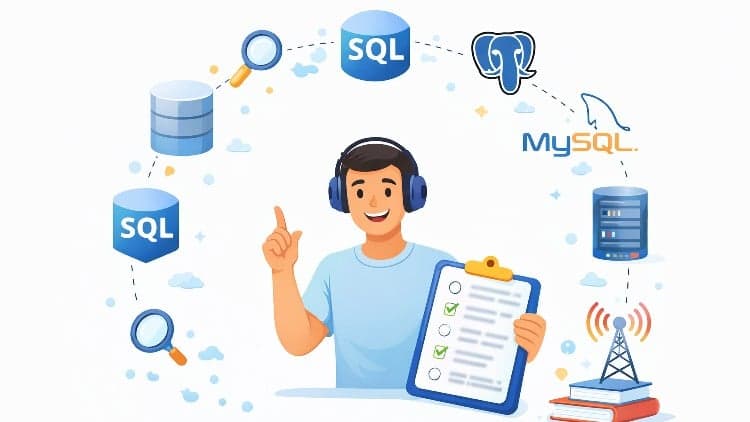
400 SQL Interview Questions with Answers 2026
Master new skills with expert-led instruction. Get 100% OFF with verified coupons and earn your certificate.
Lifetime access • Certificate included
This course includes:
- 📹0 mins on-demand video
- 📄0 articles
- 📥0 downloadable resources
- 📱Access on mobile and TV
- 🏆Certificate of completion
- ♾️Full lifetime access
📖About This Course
SQL Interview & Certification Practice Questions are meticulously designed to bridge the gap between basic syntax and the complex architectural challenges faced by modern data professionals. Whether you are preparing for a high-stakes technical interview or a professional certification, this course provides a deep dive into the engine room of relational databases, moving beyond simple SELECT statements to explore sophisticated window functions, query execution plans, and ACID-compliant transaction management. By practicing with these high-fidelity scenarios, you will develop the analytical mindset required to optimize sluggish queries, design scalable schemas from scratch, and secure databases against common vulnerabilities like SQL injection, ensuring you stand out as a top-tier candidate in a competitive job market.Exam Domains & Sample TopicsSQL Fundamentals: Joins, Subqueries, Aggregations, and NULL Handling.Performance & Optimization: CTEs, Window Functions, Indexing, and Execution Plans.Database Design: Normalization (1NF-3NF), ER Modeling, and Data Integrity.Internals & Concurrency: ACID Properties, Isolation Levels, and Deadlocks.Security & Tooling: Role-Based Access Control (RBAC), Migrations, and Cloud SQL.Sample Practice QuestionsQ1. Which of the following best describes the "Phantom Read" phenomenon in the context of database isolation levels?A) A transaction reads data that has been updated but not yet committed by another transaction.B) A transaction re-reads a row and finds that the data within that row has changed.C) A transaction executes a query twice and finds that the set of rows returned has changed due to a commit by another transaction.D) A transaction is blocked indefinitely because of a circular dependency on locks.E) A transaction fails because the underlying schema was modified during execution.F) A transaction reads data from a cache that is out of sync with the primary disk storage.Correct Answer: COverall Explanation: Phantom reads occur when new rows are added or removed by another transaction between two identical queries within the same transaction.A is incorrect: This describes a "Dirty Read."B is incorrect: This describes a "Non-repeatable Read," where existing row data changes, but no new rows appear.C is correct: This is the definition of a Phantom Read; the "set" of rows changes.D is incorrect: This describes a "Deadlock."E is incorrect: This refers to a schema stability conflict, not a data isolation phenomenon.F is incorrect: This is a cache coherency issue, not an isolation level concept.Q2. When using a Common Table Expression (CTE), which statement is true regarding its scope and behavior?A) A CTE is stored physically in the tempdb and persists until the session ends.B) A CTE can only be referenced once within the main query.C) A recursive CTE must consist of at least two query definitions: an anchor member and a recursive member.D) CTEs automatically create indexes on the result set to improve join performance.E) A CTE is a global object that can be accessed by other users on the same server.F) CTEs are strictly faster than subqueries in every SQL dialect.Correct Answer: COverall Explanation: CTEs provide a temporary result set that exists only for the duration of a single query, providing better readability and recursion capabilities.A is incorrect: CTEs are typically not stored physically like temp tables; they are usually expanded into the query.B is incorrect: A CTE can be referenced multiple times within the same statement.C is correct: All recursive CTEs require an anchor (base case) and a recursive part joined by a UNION ALL.D is incorrect: Databases do not automatically index CTEs.E is incorrect: CTEs are local to the query, not global objects like Views or Tables.F is incorrect: Performance between CTEs and subqueries is often identical as the optimizer treats them similarly.Q3. In database normalization, what is the primary requirement for a table to be in the Third Normal Form (3NF)?A) It must be in 2NF and contain at least one foreign key.B) It must be in 1NF and have no multi-valued attributes.C) It must be in 2NF and have no transitive functional dependencies.D) Every non-prime attribute must be partially dependent on the primary key.E) All columns must be indexed to ensure unique identification.F) The table must be split into at least three separate relations.Correct Answer: COverall Explanation: 3NF aims to reduce data redundancy by ensuring that non-key columns depend only on the primary key, and nothing but the key.A is incorrect: 3NF requires 2NF, but foreign keys are not the defining metric of 3NF.B is incorrect: This is the basic requirement for 1NF.C is correct: 3NF specifically targets the removal of transitive dependencies (where A -> B and B -> C).D is incorrect: 2NF requires full functional dependency; partial dependency is a violation of 2NF.E is incorrect: Indexing is a physical implementation detail, not a normalization rule.F is incorrect: There is no requirement for a specific number of tables to reach 3NF.Welcome to the best practice exams to help you prepare for your SQL Interview & Certification Practice Questions.You can retake the exams as many times as you wantThis is a huge original question bankYou get support from instructors if you have questionsEach question has a detailed explanationMobile-compatible with the Udemy app30-day money-back guarantee if you're not satisfiedI hope that by now you're convinced! And there are a lot more questions inside the course. Enroll today and take the final step toward getting certified!
Frequently Asked Questions
Q: Is this course really free?
Yes! Using our verified coupon code, you can enroll for 100% OFF. No hidden charges.
Q: Do I get a certificate?
Upon completion of all video lectures, Udemy will issue a certificate of completion.
Q: How long is my access?
Once you enroll with the coupon, you get full lifetime access to the materials.
You May Also Like

Web Development AI: Claude AI For Front End Web Development
Aprende el API IndexedDB de HTML5