500+ Appium Interview Questions with Answers 2026
Master new skills with expert-led instruction. Get 100% OFF with verified coupons and earn your certificate.
Lifetime access • Certificate included
This course includes:
- 📹0 mins on-demand video
- 📄0 articles
- 📥0 downloadable resources
- 📱Access on mobile and TV
- 🏆Certificate of completion
- ♾️Full lifetime access
📖About This Course
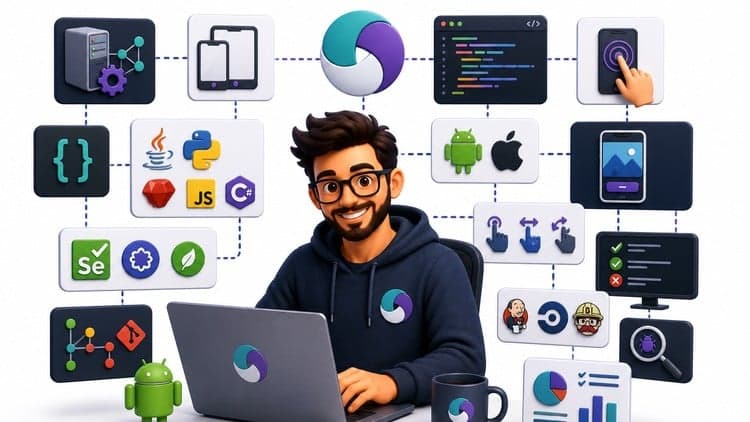
Detailed Exam Domain CoverageThis comprehensive practice exam bank is organized into eight specific technical domains to ensure structured, targeted preparation for your mobile automation interviews and certification assessments:Appium Proficiency (20%)Topics Covered: Appium Server architecture, Appium Desktop inspection tools, the evolution from JSON Wire Protocol to W3C Actions compliance, configuring advanced Desired Capabilities, and managing mobile touch interactions.Programming Knowledge (25%)Topics Covered: Object-oriented programming application in automation, writing clean test scripts using Java, Python, Ruby, JavaScript, and C#, and integrating client libraries efficiently.Mobile Testing Concepts (15%)Topics Covered: Distinguishing behaviors between Native, Hybrid, and Mobile Web applications, execution strategies, mitigating real-world mobile testing challenges, device fragmentation, and handling complex mobile gestures.Test Automation Frameworks (15%)Topics Covered: Architectural design of robust frameworks, leveraging Selenium dependencies, test execution management with TestNG and JUnit, Behavior-Driven Development (BDD) with Cucumber, and structuring Appium with Java implementations.Version Control Systems (5%)Topics Covered: Branching strategies, Git workflows, repository management on GitHub and Bitbucket, conflict resolution, and enterprise version control best practices.Continuous Integration (5%)Topics Covered: Designing CI/CD pipelines, automating test execution via Jenkins, Travis CI, and CircleCI, and configuring triggers for nightly automated regression suites.Debugging Skills (5%)Topics Covered: Advanced log analysis, interpreting Appium server logs, implementing robust exception and error handling routines, and diagnosing synchronization issues.Appium Best Practices (10%)Topics Covered: Utilizing Appium Studio, optimized server configurations, test script execution speed optimization, implementing parallel test execution across multiple devices, and building scalable test execution reporting modules.Course DescriptionSucceeding in a mobile test automation interview requires deep technical insight that goes far beyond simple UI interaction. Top engineering teams look for professionals who understand the inner workings of mobile operating systems, low-level driver communications, and scalable framework design. I developed this original question bank to provide you with the exact technical depth and situational context needed to confidently clear these rigorous assessment rounds.With 550 high-quality, scenario-based practice questions, this course serves as an exhaustive study material repository for engineers aiming to secure roles like Appium Automation Tester, Mobile Test Automation Engineer, or Senior SDET. Every question contains a thorough explanation breaking down the system mechanics behind each option, transforming every practice attempt into an active learning session.You will navigate realistic testing challenges such as managing flaky element synchronization, handling context shifts in hybrid apps, optimizing parallel execution ports, and resolving real-time driver errors. By analyzing these complex scenarios, you will develop the precise problem-solving mindset required to pass technical interviews on your first attempt.Sample Practice Questions PreviewQuestion 1: Appium Proficiency & Hybrid Application Context SwitchingAn automation engineer is testing a hybrid mobile application on an Android device. The script successfully logs into the app via native UI fields, but when it attempts to click a checkout button rendered inside an embedded web view, the execution fails with a NoSuchElementException. The element locator is verified as correct. What is the root cause of this failure, and how should it be resolved?A) The Appium server requires a complete restart because the underlying JSON Wire Protocol connection becomes corrupted when transitioning between native views and web views.Why Incorrect: The Appium server does not need a reset for context transitions. Modern Appium uses stable W3C protocol tracking, and a server restart would destroy the driver session completely, causing the entire test run to abort.B) The driver is still operating inside the NATIVE_APP context, meaning the script must explicitly fetch available contexts via driver.getContextHandles() and switch to the targeted WEBVIEW context before interacting with the element.Why Correct: Appium defaults to the native context upon session initialization. When interacting with elements rendered inside a web rendering engine (Chromium/Webkit), the driver remains blind to the web DOM until the automation script explicitly executes a context switch command to transition from the native ecosystem to the webview container.C) The application package is missing the appium:ensureWebviewsHavePages capability, which prevents the driver from locating any web views during the initial application launch.Why Incorrect: This capability helps manage timing issues when webview pages are slow to load, but missing it does not inherently prevent context switching or trigger a direct locator exception if the web page is already visible on the screen.D) The locator strategy used for the web view button must be changed to an absolute XPath using accessibility IDs instead of web standard IDs or CSS selectors.Why Incorrect: Accessibility IDs are specific to native mobile views. Once inside a web view context, standard web locators like CSS selectors and IDs are preferred and highly effective; absolute XPaths should be avoided due to flakiness.E) The developer forgot to sign the application with a debug certificate, which automatically blocks the Appium inspector tool from reading any native or web view components.Why Incorrect: While a debug build is required on Android to expose webview elements for debugging, a missing certificate would prevent the entire application from being manipulated or inspected at all, rather than throwing a targeted element missing exception inside a running session.F) The script must implement a TouchAction swipe gesture to force the web view to reload its internal DOM tree before attempting the click operation.Why Incorrect: TouchAction is deprecated in modern Appium frameworks in favor of W3C Actions. Furthermore, forcing a page reload does not address the fundamental context mismatch keeping the driver locked in native execution mode.Question 2: Appium Best Practices & Parallel Test Execution SetupYou are configuring a local test automation framework to run regression tests in parallel on three distinct physical Android devices connected to a single host machine. During initialization, the first test session launches successfully, but the subsequent sessions fail immediately with port conflict errors. Which configuration parameters must be unique for each concurrent driver instance to execute smoothly?A) Every device driver session must share the exact same appium:automationName and appium:appActivity capabilities to prevent cross-talk on the local machine host.Why Incorrect: Sharing the automation name (such as UIAutomator2) and the application activity is normal when testing the same app across devices. These do not control network port allocations and will not resolve port binding conflicts.B) Each execution thread must point to a distinct Appium server instance, and each driver instance must define unique values for appium:udid, appium:systemPort, and if using Chrome, appium:chromedriverPort.Why Correct: For parallel Android execution on a single machine, Appium must differentiate network traffic lanes for each device. The udid targets the specific hardware, the systemPort routes the communication to the individual UIAutomator2 server instances running on the devices, and the chromedriverPort isolates web view debugging traffic. Failing to segregate these specific ports causes threads to collide over the default ports.C) The framework needs to override the default Git repository endpoints to ensure that log reports are uploaded to separate branches in real-time.Why Incorrect: Git endpoints and branch configurations manage version control storage. They have no runtime interaction with local network ports or active instrumentation sessions driven by the Appium server.D) The automation suite must execute a terminal command to reassign the default Jenkins execution port for every individual test class file included in the test framework.Why Incorrect: The Jenkins master/agent port governs the CI server UI web access and build triggering pipeline. It does not dictate how localized mobile automation drivers communicate with physical mobile devices attached to a test node.E) You must change the programming language bindings so that each device runs a completely different language engine, such as one thread running Java and the other running Python.Why Incorrect: Combining multiple language bindings within a single test suite is highly inefficient and practically impossible for framework architecture. Port isolation is handled via driver capability parameters, not language runtimes.F) Each device must be configured to use a unique global proxy server IP address inside the Wi-Fi settings to allow the Appium server to bypass local firewall checks.Why Incorrect: Local execution traffic between the host machine and USB-connected devices bypasses external proxy routes. Modifying device Wi-Fi proxy settings will not resolve internal port contention issues on the host machine.Question 3: Test Automation Frameworks & Advanced Error DiagnosticsDuring the execution of a nightly automated UI test suite using Appium with Java and TestNG, an critical regression test fails consistently on a specific form page. The console output shows a StaleElementException. The element is clearly visible on the screen in screenshots captured during the failure, and a standard explicit wait was implemented. How should this error be diagnosed and corrected?A) The element visibility wait must be replaced with a hard-coded thread sleep of at least ten seconds to allow the mobile OS to fully cache the page layer.Why Incorrect: Hard-coded sleeps slow down test execution speeds significantly and fail to fix the root cause of volatility. They do not prevent stale element exceptions if the DOM or screen layout redraws right after the sleep expires.B) The Appium desktop inspector must be used to completely rewrite the locator using a dynamic CSS sibling selector that references the root parent node.Why Incorrect: Modifying the locator string does not solve a stale element issue if the underlying object reference is broken. The locator itself is valid, but the driver's internal reference hook to that element has been invalidated by a page update.C) The test framework must catch the exception, completely destroy the current driver session instance, and reinstall the application from scratch to clear the cache.Why Incorrect: Reinitializing the entire driver session and reinstalling the app for a single element interaction issue is an extreme waste of execution time that disrupts the test flow and masks underlying application performance defects.D) The script should re-query the DOM by re-initializing the element via driver.findElement() right before interaction, or wrap the logic in a fluent wait that ignores StaleElementReferenceException during polling.Why Correct: A StaleElementException occurs when the element is no longer attached to the active screen DOM interface known to the driver, often due to a subtle page redraw, animation, or screen refresh. By re-invoking findElement, the script discards the old, broken reference hook and retrieves a fresh, valid pointer to the object currently rendered on the screen.E) The developer must modify the source code to replace all native accessibility layout IDs with legacy Selenium class name identifiers.Why Incorrect: Accessibility IDs are the most stable and performant locator strategy available for mobile test automation. Reverting to broad class names makes locators fragile and increases the likelihood of finding the wrong element.F) The testing pipeline must be moved from local execution to a Cloud provider like Travis CI to automatically stabilize memory leak errors.Why Incorrect: Moving infrastructure to a cloud provider does not alter how the Appium driver interacts with a refreshing UI screen structure. The script logic itself must handle the element lifecycle state within the automation routine.Welcome to the Interview Questions Tests to help you prepare for your Appium Interview Questions practice test.You can retake the exams as many times as you wantThis is a huge original question bankYou get support from instructors if you have questionsEach question has a detailed explanationMobile-compatible with the Udemy appI hope that by now you're convinced! And there are a lot more questions inside the course.
Appium Interview Questions: Free Udemy Course - 100% Off
Limited-Time Offer: This IT Certifications Udemy course is now available completely free with our exclusive 100% discount coupon code. Originally priced at $99.99, you can enroll at zero cost and gain lifetime access to professional training. Don't miss this opportunity to master mobile test automation without spending a dime!
What You'll Learn in This Free Udemy Course
This comprehensive free online course on Udemy covers everything you need to become proficient in Appium mobile test automation. Whether you're a beginner or looking to advance your skills, this free Udemy course with certificate provides hands-on training and practical knowledge you can apply immediately.
- Master advanced Appium techniques to boost your mobile testing expertise
- Understand Appium's technical architecture and troubleshooting secrets
- Learn parallel test execution optimization for faster results
- Diagnose and resolve complex Appium server errors professionally
- Implement best practices for scalable test automation frameworks
Who Should Enroll in This Free Udemy Course?
This free certification course is perfect for anyone looking to break into software testing or enhance their mobile automation skills. Here's who will benefit most from this no-cost training opportunity:
- Career changers seeking to enter the lucrative mobile test automation field
- Software developers aiming to transition into QA engineering roles
- QA professionals wanting to specialize in Appium and Selenium
- Entry-level testers preparing for certification exams
- IT professionals targeting senior SDET positions
Meet Your Instructor
Learn from Interview Questions Tests, an experienced professional in IT education with a proven track record of helping thousands of students pass technical interviews. Their clear explanations and scenario-based approach make complex concepts easy to understand. With a focus on real-world applications, they prepare learners for actual job interviews through practical case studies.
Course Details & What Makes This Free Udemy Course Special
With an impressive 0 rating and 15 students already enrolled, this Udemy free course has proven its value. The course includes 0 comprehensive lessons, regularly updated to reflect the latest industry standards. Upon completion, you'll receive a certificate to showcase on LinkedIn and your resume. Plus, with mobile access, you can learn anytime, anywhere—perfect for busy professionals. This IT Software course in the IT Certifications niche is regularly updated and includes lifetime access, meaning you can revisit materials whenever you need a refresher.
How to Get This Udemy Course for Free (100% Off)
Follow these simple steps to claim your free enrollment:
- Click the enrollment link to visit the Udemy course page
- Apply the coupon code: AEF61F44B770B4F7B5BA at checkout
- The price will drop from $99.99 to $0.00 (100% discount)
- Complete your free enrollment before
- Start learning immediately with lifetime access
⚠️ Important: This free Udemy coupon code expires on . The course will return to its regular price after this date, so enroll now while it's completely free. This is a legitimate, working coupon—no credit card required, no hidden fees, no trial periods. Once enrolled, the course is yours forever.
Why You Should Grab This Free Udemy Course Today
Here's why this free certification course is an opportunity you can't afford to miss: Master in-demand mobile testing skills that open doors to high-paying roles. Broaden your career prospects with hands-on Appium practice. These skills lead to significant salary increases, flexible freelance opportunities, and advancement into leadership positions.
Frequently Asked Questions About This Free Udemy Course
Is this Udemy course really 100% free?
Yes! By using our exclusive coupon code AEF61F44B770B4F7B5BA, you get 100% off the regular $99.99 price. This makes the entire course completely free—no payment required, no trial period, and no hidden costs. You'll have full access to all course materials just like paying students.
How long do I have to enroll with the free coupon?
This limited-time offer expires on . After this date, the course returns to its regular price. We highly recommend enrolling immediately to secure your free access. The coupon has limited redemptions available.
Will I receive a certificate for this free Udemy course?
Absolutely! Upon completing all course requirements, you'll receive an official Udemy certificate of completion. This certificate can be downloaded, shared on LinkedIn, and added to your resume to showcase your new skills to employers.
Can I access this course on my phone or tablet?
Yes! This course is fully compatible with the Udemy mobile app for iOS and Android. Download the app, enroll with the free coupon, and learn on-the-go. You can watch videos, complete exercises, and track your progress from any device.
How long do I have access to this free course?
Once you enroll using the free coupon code, you get lifetime access to all course materials. There's no time limit—learn at your own pace, revisit lessons anytime, and benefit from future updates at no additional cost. Your one-time free enrollment gives you permanent access.
Frequently Asked Questions
Q: Is this course really free?
Yes! Using our verified coupon code, you can enroll for 100% OFF. No hidden charges.
Q: Do I get a certificate?
Upon completion of all video lectures, Udemy will issue a certificate of completion.
Q: How long is my access?
Once you enroll with the coupon, you get full lifetime access to the materials.
You May Also Like

Google Professional Agentic Architect — 1500 Exam Questions

Building Data Warehouse with Snowflake, Python and SQL