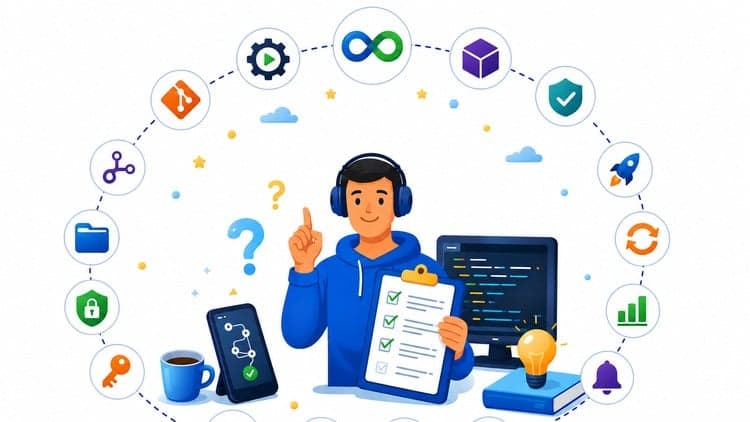
500+ CI/CD Interview Questions with Answers 2026
Master new skills with expert-led instruction. Get 100% OFF with verified coupons and earn your certificate.
Lifetime access • Certificate included
This course includes:
- 📹0 mins on-demand video
- 📄0 articles
- 📥0 downloadable resources
- 📱Access on mobile and TV
- 🏆Certificate of completion
- ♾️Full lifetime access
📖About This Course
Detailed Exam Domain CoverageThis practice test bank is organized directly around the core architectural blueprints, engineering practices, and security principles evaluated in modern DevOps and CI/CD engineering interviews:CI/CD Pipelines (25%)Topics Covered: End-to-end pipeline design, build automation engines, continuous integration architectures, continuous deployment frameworks, and distributed build execution models.Testing and Validation (20%)Topics Covered: Automated test orchestration, unit testing isolation, integration testing environments, UI and end-to-end automated testing, and test coverage optimization patterns.Deployment and Release Management (15%)Topics Covered: Advanced deployment strategies (Canary, Blue-Green, Rolling updates), immutable infrastructure releases, orchestration engine rollbacks, and release gates.Version Control (10%)Topics Covered: Git internal mechanics, multi-developer repository management, scalable branching strategies (GitFlow, Trunk-Based Development), clean conflict merging, and webhook triggering.Security and Compliance (10%)Topics Covered: Dynamic secrets management, pipeline role-based access control (RBAC), code and dependency encryption, automated security compliance scanning, and immutable audit logging.Tools and Technologies (10%)Topics Covered: Container orchestration engine integration (Docker, Kubernetes), build runners, and cloud-native execution using platforms like Jenkins, Travis CI, and CircleCI.Monitoring and Logging (5%)Topics Covered: Automated error tracking loops, pipeline telemetry and logging mechanisms, system performance metrics, and pro-active real-time alerting systems.DevOps and Culture (5%)Topics Covered: Core DevOps tenets, cross-functional Agile methodology integration, developer-to-operations collaboration models, and systemic continuous improvement frameworks.Course DescriptionBuilding, maintaining, and scaling high-throughput automation systems requires deep architectural knowledge and sharp problem-solving skills. In a standard technical or architectural interview, hiring managers look beyond tool syntax. They want to see how you handle race conditions in distributed agents, flaky test suites, unsafe credential handling, or zero-downtime deployment failures. I developed this comprehensive practice test database to mirror those exact high-stakes scenarios.Featuring 550 meticulously prepared, original questions, this course functions as an intensive study aid to validate your engineering judgment. It targets mid-level to advanced professionals aiming for specialized DevOps, Release Management, or CI/CD Infrastructure roles. Every scenario is built around real-world engineering friction points—such as pipeline resource constraints, broken container handshakes, and strict regulatory compliance audits.Every question comes paired with an exhaustive breakdown of the entire problem landscape. Instead of simply checking off the correct choice, I explain the underlying architectural logic of the system, helping you understand why specific options fail under heavy production stress. This structured approach helps ensure you develop the technical clarity required to address challenging engineering prompts smoothly and pass your professional assessments on your first attempt.Sample Practice Questions PreviewQuestion 1: Pipeline Design and Build OptimizationA DevOps team reports that a multi-stage Docker build pipeline running on a shared Jenkins agent has slowed down dramatically over two weeks. The pipeline pulls a heavy base image, updates system packages, compiles a complex enterprise application, runs tests, and pushes the artifact. The cache appears to miss on almost every run, even when code changes are minimal. Which action should you take first to fix the caching mechanisms and optimize build speed?A) Move the COPY . . instruction to the very top of the Dockerfile, right after the FROM statement, to ensure all files are available immediately.Why Incorrect: Placing the complete file copy step at the beginning invalidates the build cache for every subsequent layer whenever any local file changes, which worsens the cache-miss problem instead of solving it.B) Disable layer caching entirely inside the Jenkinsfile options block to force a clean, predictable workspace initialization on every run.Why Incorrect: Disabling the layer cache forces the runner to execute every step from scratch on every single execution, increasing build times and resource consumption.C) Ensure that stable dependencies (like package lockfiles) are copied and installed before copying the remaining volatile application source code.Why Correct: Container build engines evaluate cache validity sequentially. By copying structural files (like package.json or pom.xml) and running the installation command before copying the highly volatile source code, you ensure the heavy dependency layer is only rebuilt when dependencies change, maximizing cache utilization.D) Configure an automated cron job to completely wipe the Docker builder cache directory on the host machine every three hours.Why Incorrect: Constantly wiping the host cache destroys valid layers that could have been reused, increasing network transit and compute overhead for the base images.E) Switch the execution engine from Docker to a legacy virtual machine runner that does not rely on layer caching systems.Why Incorrect: Moving away from containers introduces environment drift, slows down process provisioning times, and fails to fix the underlying architectural flaw in the step order.F) Replace the base image with a completely blank scratch image and manually script all system tool installations during runtime.Why Incorrect: Building from scratch without pre-compiled tools forces the pipeline to compile basic operating system tools on every run, increasing overall build durations.Question 2: Advanced Deployment Strategies and RollbacksAn automated release pipeline triggers a Blue-Green deployment to a production Kubernetes cluster. The new production environment (Green) goes live, and user traffic is rerouted via an ingress controller change. Ten minutes post-deployment, automated application monitoring registers a spike in 5xx server errors on specific legacy database query pathways. Which action represents the most reliable, industry-standard automated rollback pattern?A) Immediately trigger a rapid code hotfix in the version control system, commit it directly to main, and wait for the entire CI pipeline to run again.Why Incorrect: Waiting for a brand-new pipeline build to run while production is throwing 5xx errors extends user downtime significantly and risks introducing unverified errors.B) Shift the ingress traffic routing back to the stable Blue environment immediately, leaving the Green environment isolated for post-mortem diagnostics.Why Correct: The primary advantage of a Blue-Green architecture is near-instantaneous traffic switching. Pointing the ingress routing back to the intact, active Blue environment instantly restores stable service to users while preserving the broken Green environment for isolated troubleshooting.C) Manually SSH into individual production containers in the Green environment to adjust configuration parameters on live active pods.Why Incorrect: Modifying live containers violates the core principle of immutable infrastructure, introduces unpredictable environment state configurations, and is impossible to scale reliably.D) Initiate a database table drop and restore the complete system from the previous midnight cold storage backup file.Why Incorrect: Dropping production tables to resolve an application routing layer bug causes severe data loss for transactions executed between midnight and the current deployment time.E) Execute a hard restart command on all network switches and routing gear across the active hosting zone.Why Incorrect: Power cycling infrastructure components introduces widespread system instability, impacts unrelated applications, and does not address the application query bug.F) Delete both the Blue and Green environments simultaneously to clear the cluster state, then trigger a manual infrastructure rebuild.Why Incorrect: Purging both environments results in total service blackout for users, turning a minor database path failure into a critical production outage.Question 3: Security, Secrets Management, and ComplianceA security audit reveals that an organization's CI/CD pipelines are vulnerable because third-party plug-ins can read cleartext environment variable secrets stored within the orchestration engine configuration page. Which architectural pattern should you execute to secure sensitive credentials across all active workflows?A) Encrypt the raw secrets strings using a public tool online and store the plain output text as unencrypted comments within the application repository.Why Incorrect: Storing hardcoded secrets or easily cracked text blocks directly inside a public or private code repository compromises security and exposes credentials to anyone with read access to the code.B) Embed the database passwords and API keys directly inside the application source code files to reduce dependency on external orchestration platforms.Why Incorrect: Hardcoding sensitive access tokens into code strings creates an immediate risk of credential exposure and complicates secret rotation, violating basic security compliance protocols.C) Integrate a dedicated external secrets manager that injects ephemeral, short-lived tokens directly into container memory during runtime execution phases.Why Correct: Utilizing an external, programmatic vault ensures that secrets are kept outside the pipeline's persistent configuration files. Injecting short-lived credentials directly into volatile execution memory limits exposure windows and ensures robust audit logging for access requests.D) Instruct the engineering teams to change their deployment passwords manually via the CLI tools right before every single automated execution.Why Incorrect: Requiring manual inputs defeats the purpose of automated pipelines, introduces human error risks, and breaks continuous deployment cadences.E) Route all pipeline logs into an open, unauthenticated logging server so developers can manually review secret injections.Why Incorrect: Broadening log permissions exposes sensitive environment variables to unauthorized eyes, violating core privacy and access control principles.F) Remove all authorization, access controls, and authentication layers from production backend components to eliminate the need for storing secrets.Why Incorrect: Eliminating authorization layers leaves production servers open to unauthorized public access, creating a catastrophic security breach.Welcome to the Interview Questions Tests to help you prepare for your CI/CD Interview Questions Practice Test.You can retake the exams as many times as you wantThis is a huge original question bankYou get support from instructors if you have questionsEach question has a detailed explanationMobile-compatible with the Udemy appI hope that by now you're convinced! And there are a lot more questions inside the course.
Frequently Asked Questions
Q: Is this course really free?
Yes! Using our verified coupon code, you can enroll for 100% OFF. No hidden charges.
Q: Do I get a certificate?
Upon completion of all video lectures, Udemy will issue a certificate of completion.
Q: How long is my access?
Once you enroll with the coupon, you get full lifetime access to the materials.
You May Also Like
Informatica IDMC Customer 360 SaaS Data Modeling Masterclass
AI in Healthcare: The Complete Practitioner's Playbook