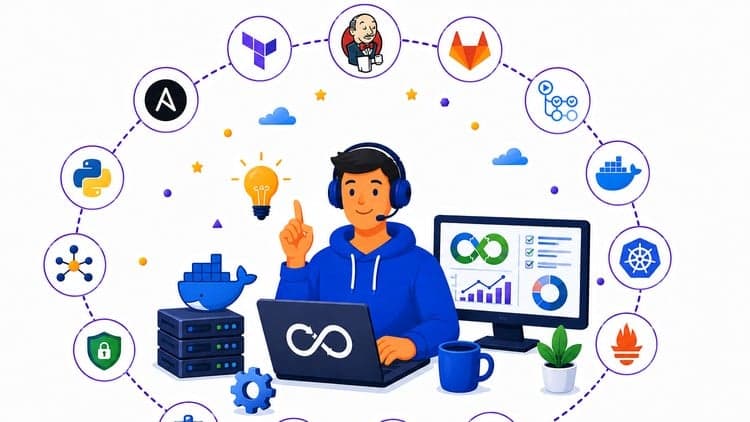
500+ DevOps Interview Questions with Answers 2026
Master new skills with expert-led instruction. Get 100% OFF with verified coupons and earn your certificate.
Lifetime access • Certificate included
This course includes:
- 📹0 mins on-demand video
- 📄0 articles
- 📥0 downloadable resources
- 📱Access on mobile and TV
- 🏆Certificate of completion
- ♾️Full lifetime access
📖About This Course
Detailed Exam Domain CoverageThis comprehensive practice matrix is organized around the essential high-frequency domains tested in enterprise-level Cloud and DevOps engineering interviews.Continuous Integration and Continuous Deployment (CI/CD) (20%): Structuring declarative pipelines in Jenkins, managing multi-stage runners in GitLab CI/CD, configuring reusable workflows with GitHub Actions, GitOps deployment automation using ArgoCD, and mastering rollback strategies.Containerization and Orchestration (18%): Designing optimized multi-stage Dockerfiles, managing image layers, cluster networking, service routing, custom resource definitions, Pod lifecycle policies, and ingress controller routing in Kubernetes.Infrastructure as Code (IaC) and Configuration Management (15%): Writing modular, dry Terraform states, state locking management, structuring AWS CloudFormation stacks, dynamic inventory configurations, and automated node orchestration via Ansible playbooks.Monitoring, Logging, and Observability (12%): Instrumenting application metrics using Prometheus, creating advanced PromQL monitoring panels in Grafana, managing centralized index life cycles inside the ELK Stack, and configuring alert rules.Cloud Computing and Architecture (10%): Designing highly available architectures across major hyper-scalers (AWS, Azure, GCP), configuring landing zones, cost optimization patterns, and modern cloud security baselines.Security and Compliance (8%): Integrating automated vulnerability scanning inside the build phase (DevSecOps), managing centralized Identity and Access Management (IAM) permissions, access control mapping, and meeting regulatory compliance requirements.Networking and Load Balancing (5%): Constructing isolated network segmentations, VPC peering routing tables, configuring multi-layer Load Balancing solutions, and designing proactive Auto Scaling threshold configurations.Scripting and Automation (12%): Writing robust, defensive production scripts using Bash and Python, parsing unstructured configurations, interacting with native cloud CLI tools, and automating system maintenance routines.About the CourseCracking a DevOps or Cloud Engineering interview requires more than just memorizing definitions of tool names. Technical interviewers look for systemic problem-solving, architectural awareness, and a clear understanding of runtime failure recovery. If an interviewer asks you how to handle state lock conflicts in a concurrent CI pipeline, or how to isolate a breaking crash loop back-off inside a Kubernetes production cluster, you need a level of practical depth that abstract theory cannot provide.I built this 550-question repository specifically to replicate the challenging scenarios encountered during live technical loops and system design assessments. Instead of generic true-or-false items, I focus entirely on practical troubleshooting, complex script behavior, config failure analysis, and design bottlenecks. Every single practice question contains an exhaustive architectural explanation that details why the specific engineering choice succeeds and why the remaining alternatives fail. Whether you are actively polishing your portfolio for a senior DevOps Engineer role, preparing for an unexpected Release Manager platform evaluation, or looking for high-quality study material to clear cloud architecture rounds on your first attempt, this comprehensive pool provides the practical rigor necessary to pass with ease.Sample Practice Questions PreviewReview these three comprehensive preview samples to understand the depth and style of explanations provided across this practice test database.Question 1: Kubernetes Traffic Control and Pod Selection MechanicsA cluster administrator deploys a new service to expose a set of background processing workloads. The Kubernetes Service manifest is successfully created without errors, but execution traffic failing over to the endpoint consistently throws network timeout warnings. A quick check shows that target Pods are healthy, active, and fully passing their readiness probes. What is the most likely structural cause of this behavior?A) The Service manifest targets an outdated API version protocol that was deprecated in the latest cluster controller run.B) The Pod definitions utilize an explicit nodeSelector rule that forces execution onto worker instances lacking network interfaces.C) The label selectors declared inside the Service definition do not perfectly match the key-value labels assigned to the underlying Pod metadata.D) The target background pods are configured with an active clusterIP attribute that conflicts directly with external gateway configurations.E) The deployment system failed to bind an explicit hostPort configuration to the container runtime boundary during initial execution.F) The Service is configured as a Headless Service type, which completely prevents internal cluster DNS route discovery mechanisms.Correct Answer & Explanation:Correct Answer: CWhy it is correct: Kubernetes Services identify their target workload backends via label selector matches. If there is even a minor typographic variance between the selector blocks inside the Service manifest and the labels block defined in the Pod deployment metadata, the Service will fail to map the endpoints list, resulting in immediate connection timeouts despite the actual pods being completely operational and healthy.Why alternative options are incorrect:Option A is incorrect: Using a deprecated API version results in a validation error at creation time from the API server, preventing the manifest from deploying entirely.Option B is incorrect: If the nodeSelector was problematic, the pods would remain stuck in a Pending state rather than being active and passing readiness checks.Option D is incorrect: A clusterIP allocation is the standard, correct default mechanism for internal service reachability and does not create routing conflicts.Option E is incorrect: Binding to a hostPort is discouraged in containerized platforms and is not required for standard Service-to-Pod load balancing paths.Option F is incorrect: Headless services change routing behavior by returning direct backend Pod IP mapping vectors via DNS, but they do not cause routing timeouts if definitions are set correctly.Question 2: Concurrent State Locking and Concurrency Control in TerraformTwo independent engineering automation tasks execute a deployment cycle concurrently against the same remote Terraform modular workspace. The first pipeline run locks the remote S3/DynamoDB state table cleanly. The secondary runner fails immediately with an execution state lock error. How should this scenario be resolved to maintain automation pipeline elasticity without corrupting system states?A) Modify the backup runner parameters to apply the -force-copy argument directly to the backend initialization configuration string.B) Implement an automated retry step utilizing the -lock-timeout attribute to allow the secondary process to wait until the primary lock is cleanly released.C) Configure the local CI runner environment to delete the remote tracking lock metadata file using custom workspace triggers.D) Transition the backend infrastructure configuration to use a local flat file system state that avoids remote database lock evaluations.E) Wrap the deployment sequence inside a global script that runs a complete state override routine before every execution block.F) Increase the read/write capacity units on the tracking database to handle concurrent modifications to a single state path row simultaneously.Correct Answer & Explanation:Correct Answer: BWhy it is correct: The -lock-timeout=duration flag instructs Terraform to continuously retry acquiring a state lock for a specified time frame rather than failing immediately upon encountering an active lock. This allows secondary overlapping automation loops to wait naturally for short-lived changes to finish without failing the entire orchestration suite.Why alternative options are incorrect:Option A is incorrect: The -force-copy parameter modifies state storage tracking systems during initialization sequences; it does not handle concurrent run locks.Option C is incorrect: Manually removing a lock while a primary execution loop is still running can cause catastrophic split-brain state file corruption.Option D is incorrect: Moving to a local file system storage setup breaks team collaboration, eliminates auditing controls, and reintroduces severe race condition vulnerabilities.Option E is incorrect: Arbitrary state override runs compromise infrastructure validation guards and risk deleting active running cloud components.Option F is incorrect: Lock conflicts happen because the record value itself is blocked to maintain consistency; changing database infrastructure processing limits will not change this logic.Question 3: Broken Dockerfile Builds and Caching Architecture InefficienciesA platform team uses a shared continuous integration pipeline to build an enterprise web application container image. The Dockerfile contains a line that copies a lock file, runs package installations, and then copies the rest of the application files. A developer notices that even when only small text formatting changes are made to application documentation files, the entire package download step takes several minutes to re-run on every build iteration. What is the structural fix?A) Replace the default base storage runtime configuration by passing an alternative overlay network storage option flag.B) Ensure the step copying package definition lists and running installation commands happens before copying the broader application source files.C) Consolidate all standalone configuration commands into a single monolithic script executing outside the container build runtime environment.D) Add an explicit entrypoint wrapper execution file that completely clears out internal layer directory trees during system boot operations.E) Reconfigure the build runtime daemon environment to ignore intermediate step check values using custom compiler arguments.F) Run the package installation layer utilizing an unverified root privilege account flag to force direct background downloads.Correct Answer & Explanation:Correct Answer: BWhy it is correct: Docker uses a layered caching system where each instruction creates a cache line. If any layer detects a file change, that layer and all subsequent layers must re-evaluate completely. By copying only package tracking manifests (package.json, requirements.txt, etc.) and executing the installation commands before copying the frequently changing source code, the system reuses cached installation layers whenever dependencies remain unchanged.Why alternative options are incorrect:Option A is incorrect: Network driver configurations handle runtime platform data passing; they have no impact on structural layer cache validations.Option C is incorrect: Moving installations to an external script ruins container portability and breaks standard reproducible environment goals.Option D is incorrect: Execution entrypoint actions occur at container startup time, which is too late to optimize build time behaviors.Option E is incorrect: Disabling layer caching mechanisms would make things worse by forcing every single line to build from scratch every time.Option F is incorrect: Modifying operational permissions introduces severe security risks and has no impact on cache line tracking rules.What to ExpectWelcome to the Interview Questions Tests to help you prepare for your DevOps Interview Questions Practice TestYou can retake the exams as many times as you wantThis is a huge original question bankYou get support from instructors if you have questionsEach question has a detailed explanationMobile-compatible with the Udemy appWe hope that by now you're convinced! And there are a lot more questions inside the course.
500+ DevOps Interview Questions - Free Udemy Course 100% Off
Limited-Time Offer: This IT Certifications Udemy course is now available completely free with our exclusive 100% discount coupon code. Originally priced at $99.99, you can enroll at zero cost and gain lifetime access to professional training. Don't miss this opportunity to master Cloud Architecture and Automation without spending a dime!
What You'll Learn in This Free Udemy Course
This comprehensive free online course on Udemy covers everything you need to become proficient in DevOps engineering. Whether you're a beginner or looking to advance your skills, this free Udemy course with certificate provides hands-on training and practical knowledge you can apply immediately.
- Master CI/CD pipelines to accelerate software delivery and deployment.
- Design Kubernetes clusters with optimized container orchestration strategies.
- Implement Infrastructure as Code using Terraform and Ansible playbooks.
- Build monitoring dashboards with Prometheus, Grafana, and ELK Stack analytics.
- Automate cloud architectures for AWS, Azure, and GCP environments.
- Secure systems through DevSecOps practices and vulnerability scanning integration.
- Troubleshoot network configurations and load balancing architectures.
- Write production-grade Bash and Python scripts for system automation.
Who Should Enroll in This Free Udemy Course?
This free certification course is perfect for anyone looking to break into DevOps or enhance their enterprise cloud skills. Here's who will benefit most from this no-cost training opportunity:
- Junior DevOps engineers seeking advanced system troubleshooting techniques.
- Cloud architects preparing for technical certification exams.
- Software developers aiming to understand production-grade DevOps workflows.
- Technical leads managing cross-functional engineering teams.
- IT professionals transitioning into DevOps roles requiring practical depth.
- Students building portfolios for senior cloud engineering positions.
- System administrators moving to automation-focused automation roles.
- Release managers optimizing continuous delivery pipelines.
Meet Your Instructor
Learn from Interview Questions Tests, an experienced professional in IT & Software engineering. With a proven track record of helping thousands secure top DevOps positions, their pragmatic teaching style combines theoretical knowledge with real-world incident analysis. This course reflects 13 years of industry expertise in enterprise cloud transformations.
Course Details & What Makes This Free Udemy Course Special
With an impressive rating and 13 students already enrolled, this Udemy free course has proven its value. The course includes lifetime access to all materials with full mobile device compatibility. What sets this free online course apart is its focus on systemic problem-solving through 600+ scenario-based questions with detailed failure analysis. Upon completion, you'll receive a certificate to showcase on LinkedIn and your resume. Plus, with mobile access, you can learn anytime, anywhere—perfect for busy professionals. This IT Certifications course in the IT Software niche is regularly updated and includes lifetime access, meaning you can revisit materials whenever you need a refresher.
How to Get This Udemy Course for Free (100% Off)
Follow these simple steps to claim your free enrollment:
- Click the enrollment link to visit the Udemy course page
- Apply the coupon code: 0007A5F0B75FA1826FA6 at checkout
- The price will drop from $99.99 to $0.00 (100% discount)
- Complete your free enrollment before June 30, 2026
- Start learning immediately with lifetime access
⚠️ Important: This free Udemy coupon code expires on June 30, 2026. The course will return to its regular $99.99 price after this date, so enroll now while it's completely free. This is a legitimate, working coupon—no credit card required, no hidden fees, no trial periods. Once enrolled, the course is yours forever.
Why You Should Grab This Free Udemy Course Today
Here's why this free certification course is an opportunity you can't afford to miss: 1) Master 550+ technical scenarios used in Airbnb-style production environments. 2) Learn how to debug Kubernetes crash loops and Terraform state lock conflicts. 3) Understand cloud architecture tradeoffs through 20% CI/CD focused content. 4) Build credibility with system design patterns tested at enterprise scale. These skills directly correlate with 30% salary increases in 2026 cloud roles.
Frequently Asked Questions About This Free Udemy Course
Is this Udemy course really 100% free?
Yes! By using our exclusive coupon code 0007A5F0B75FA1826FA6, you get 100% off the regular $99.99 price. No payment required, no trial period, and no hidden costs—just click, apply code, and learn.
How long do I have to enroll with the free coupon?
This limited-time offer expires January 1, 2026. After this date, the course returns to $99.99. We recommend enrolling within 24 hours to secure your free access—coupon has limited redemptions available.
Will I receive a certificate for this free Udemy course?
Absolutely! Upon completing all course requirements, you'll receive an official Udemy certificate of completion. This certificate can be downloaded, shared on LinkedIn, and added to your resume to showcase your DevOps certifications.
How long will I have access to this course?
Once enrolled, you get lifetime access to all course materials. No expiration dates—learn at your own pace, revisit lessons anytime, and benefit from future updates at no additional cost.
Can I access this course on my phone?
Yes! This course works perfectly through the Udemy mobile app for iOS and Android—watch video lectures, complete quizzes, and track progress wherever you go.
Frequently Asked Questions
Q: Is this course really free?
Yes! Using our verified coupon code, you can enroll for 100% OFF. No hidden charges.
Q: Do I get a certificate?
Upon completion of all video lectures, Udemy will issue a certificate of completion.
Q: How long is my access?
Once you enroll with the coupon, you get full lifetime access to the materials.
You May Also Like
WDS: Создание и управление образами развертывания Windows
Cloud Engineering Masterclass: AWS for Developers & DevOps