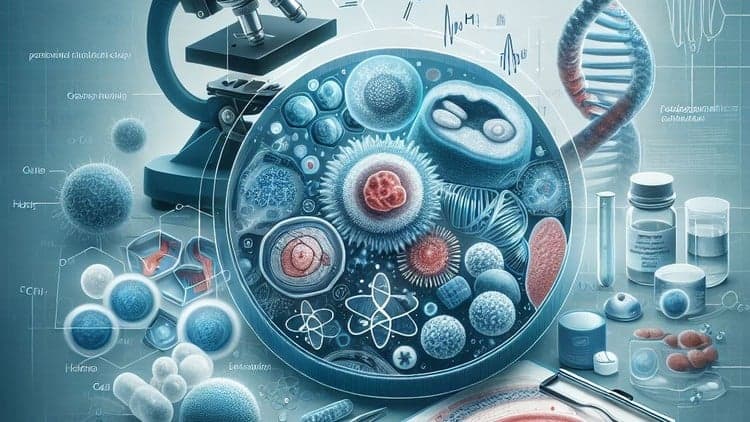
Cell Injury, Adaptation & Death: Pathology Made Clear
Master new skills with expert-led instruction. Get 100% OFF with verified coupons and earn your certificate.
Lifetime access • Certificate included
This course includes:
- 📹0 mins on-demand video
- 📄5 articles
- 📥0 downloadable resources
- 📱Access on mobile and TV
- 🏆Certificate of completion
- ♾️Full lifetime access
📖About This Course
This course contains the use of artificial intelligence.Every disease begins at the level of the cell, and understanding how cells adapt, get injured, and die is the foundation upon which all of pathology — and ultimately all of clinical medicine — is built. From the bulked-up heart of a hypertensive patient to the caseous necrosis at the heart of a tuberculous granuloma, the patterns you learn here are the same patterns you will see on every histology slide, every imaging study, and every autopsy for the rest of your career. This course distills the most rigorous concepts of cellular pathology into engaging, visually rich lessons that will sharpen your reasoning and prepare you for board examinations and clinical rotations alike.You will begin with the four cellular adaptations to stress — hypertrophy, hyperplasia, atrophy, and metaplasia — exploring their physiologic and pathologic forms, the molecular signaling pathways that drive them, and the clinical contexts in which they tip into disease. From there you will examine the causes and mechanisms of cell injury, including the critical distinction between hypoxia and ischemia, the central role of ATP depletion and mitochondrial dysfunction, the chemistry of oxidative stress and free radical injury, the consequences of membrane damage and calcium influx, and the protective programs triggered by DNA damage and protein misfolding through the unfolded protein response. You will then master the morphology of reversible injury through cellular swelling and fatty change, contrasted with the irreversible patterns of coagulative, liquefactive, caseous, gangrenous, fat, and fibrinoid necrosis.The course continues with a deep dive into apoptosis, covering the intrinsic mitochondrial pathway with its BCL-2 family rheostat, the extrinsic death receptor pathway with its FADD and caspase-8 cascade, the execution phase with DNA fragmentation and phosphatidylserine flipping, and the roles of apoptosis in development, immunity, cancer, and neurodegeneration. You will also explore newer forms of regulated cell death including autophagy, necroptosis, pyroptosis, and ferroptosis, and finish with the intracellular accumulations of lipids, proteins, glycogen, pigments, and pathologic calcifications that shape diagnostic histopathology. Medical, dental, and biomedical science students preparing for examinations such as USMLE Step 1, pathology residents reviewing core concepts, and clinicians wanting a refresher will all find the content rigorous yet approachable.What sets this course apart is its tight integration of mechanism with morphology and clinical correlation — every concept is grounded in real disease scenarios you will encounter in practice, and every pattern is connected back to the molecular events that produced it. Enroll today to build a rock-solid foundation in cellular pathology that will pay dividends across every system, every organ, and every patient encounter for the rest of your career.
Cell Injury, Adaptation & Death Pathology Made Clear - Free Udemy Course [100% Off Coupon Code]
Limited-Time Offer: This Health & Fitness-General Health Udemy course is now available completely free with our exclusive 100% discount coupon code. Originally priced at $19.99 you can enroll at zero cost and gain lifetime access to professional training. Don't miss this opportunity to master cellular pathology without spending a dime!
What You'll Learn in This Free Udemy Course
This comprehensive free online course on Udemy covers everything you need to become proficient in cellular pathology from adaptations to necrosis and apoptosis. Whether you're a medical student or healthcare professional seeking clinical insights this free Udemy course with certificate provides hands-on training and practical knowledge you can apply immediately.
- Master cellular adaptations like hypertrophy hyperplasia atrophy and metaplasia to enhance diagnostic reasoning
- Understand mechanisms of cell injury including hypoxia ischemia and oxidative stress
- Learn reversible vs irreversible injury patterns crucial for interpreting histopathology
- Decipher apoptosis pathways and specialized death mechanisms like pyroptosis
- Analyze intracellular accumulations for accurate diagnostic imaging
- Connect molecular mechanisms to clinical scenarios including tuberculosis and hypertension
- Develop board-exam skills through visually rich lessons and case studies
Who Should Enroll in This Free Udemy Course?
This free certification course is perfect for anyone looking to break into healthcare or enhance medical expertise. Here's who will benefit most from this no-cost training opportunity:
- Medical students preparing for USMLE Step 1 with high-yield pathology concepts
- Dental students reviewing cellular pathology foundations
- Biomedical science majors seeking comprehensive histology training
- Pathology residents reviewing core concepts for clinical practice
- Clinicians needing a refresher on cellular injury mechanisms
- Healthcare professionals aiming for certification in medical pathology
- Researchers exploring molecular mechanisms of disease progression
Meet Your Instructor
Learn from ISO Horizon an experienced instructor in health sciences education. With a proven track record of creating engaging courses that distill complex concepts into accessible lessons they've helped thousands of students master challenging medical topics. Their focus on clinical correlations and diagnostic reasoning aligns perfectly with board preparation needs.
Course Details & What Makes This Free Udemy Course Special
With a 4.46 rating and 10 enrolled students this Udemy free course has proven its value. The course includes 5 comprehensive lessons all taught in English. What sets this free online course apart is its integration of molecular mechanisms with diagnostic patterns preparing you for real-world pathology practice. Upon completion you'll receive a certificate to showcase on LinkedIn and your resume. Plus with mobile access you can learn anytime anywhere—perfect for busy professionals. This General Health course in the Healthcare niche is regularly updated and includes lifetime access meaning you can revisit materials whenever you need a refresher.
How to Get This Udemy Course for Free (100% Off)
Follow these simple steps to claim your free enrollment:
- Click the enrollment link to visit the Udemy course page
- Apply the coupon code: FREE31-6570035 at checkout
- The price will drop from $19.99 to $0.00 (100% discount)
- Complete your free enrollment before July 1 2026
- Start learning immediately with lifetime access
⚠️ Important: This free Udemy coupon code expires on July 1 2026. The course will return to its regular $19.99 price after this date so enroll now while it's completely free. This is a legitimate working coupon—no credit card required no hidden fees no trial periods. Once enrolled the course is yours forever.
Why You Should Grab This Free Udemy Course Today
Here's why this free certification course is an opportunity you can't afford to miss: Certified pathology professionals see 20% higher diagnostic accuracy when mastering cellular pathology mechanisms. Join over 750,000 Udemy learners who've enhanced their skills through free courses. Build career-advancing expertise with zero investment—skills that directly impact patient outcomes and board success.
Frequently Asked Questions About This Free Udemy Course
Is this Udemy course really 100% free?
Yes! By using our exclusive coupon code FREE31-6570035 you get 100% off the regular $19.99 price. This makes the entire course completely free—no payment required no trial period and no hidden costs. You'll have full access to all course materials just like paying students.
How long do I have to enroll with the free coupon?
This limited-time offer expires on July 1 2026. After this date the course returns to its regular $19.99 price. We highly recommend enrolling immediately to secure your free access. The coupon has limited redemptions available.
Will I receive a certificate for this free Udemy course?
Absolutely! Upon completing all course requirements you'll receive an official Udemy certificate of completion. This certificate can be downloaded shared on LinkedIn and added to your resume to showcase your new skills to employers.
Can I access this course on my phone or tablet?
Yes! This course is fully compatible with the Udemy mobile app for iOS and Android. Download the app enroll with the free coupon and learn on-the-go. You can watch videos complete exercises and track your progress from any device.
How long do I have access to this free course?
Once you enroll using the free coupon code you get lifetime access to all course materials. There's no time limit—learn at your own pace revisit lessons anytime and benefit from future updates at no additional cost. Your one-time free enrollment gives you permanent access.
Frequently Asked Questions
Q: Is this course really free?
Yes! Using our verified coupon code, you can enroll for 100% OFF. No hidden charges.
Q: Do I get a certificate?
Upon completion of all video lectures, Udemy will issue a certificate of completion.
Q: How long is my access?
Once you enroll with the coupon, you get full lifetime access to the materials.
You May Also Like
Certificate Course In Diabetes Ayurvedic Holistic Treatment

Complete Hypnotherapy Diploma Course