Characterization Techniques for Solid Materials
Master new skills with expert-led instruction. Get 100% OFF with verified coupons and earn your certificate.
Lifetime access • Certificate included
This course includes:
- 📹0 mins on-demand video
- 📄2 articles
- 📥0 downloadable resources
- 📱Access on mobile and TV
- 🏆Certificate of completion
- ♾️Full lifetime access
📖About This Course
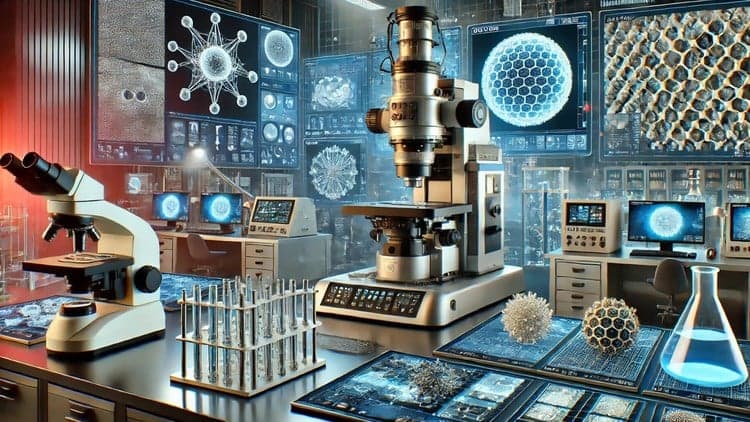
Characterization Techniques for Solid Materials provides a comprehensive introduction to the fundamental principles, methodologies, and applications of modern techniques used to investigate and analyze solid materials. The course focuses on understanding material structure, composition, morphology, crystallinity, defects, and physical properties from the atomic scale to the macroscopic level.The course begins with the fundamentals of material characterization and its importance in materials science, solid-state physics, chemistry, engineering, nanotechnology, and related fields. It introduces major categories of characterization techniques, including structural characterization, microscopy, and spectroscopy.Structural characterization techniques such as X-Ray Diffraction (XRD), Neutron Diffraction, and Electron Diffraction are explored for determining crystal structures, phase composition, lattice parameters, crystallinity, atomic arrangements, crystal orientation, and structural defects.The microscopy section covers Optical Microscopy, Scanning Electron Microscopy (SEM), Transmission Electron Microscopy (TEM), Atomic Force Microscopy (AFM), and Scanning Tunneling Microscopy (STM). These methods are used to examine surface morphology, grain structure, particle size, microstructure, defects, interfaces, and nanoscale or atomic-scale features.The course also introduces important spectroscopic techniques, including Energy Dispersive X-ray Spectroscopy (EDS/EDX), X-Ray Photoelectron Spectroscopy (XPS), Auger Electron Spectroscopy (AES), and Fourier Transform Infrared Spectroscopy (FTIR) for investigating elemental composition, chemical states, surface chemistry, and molecular bonding.For each technique, emphasis is placed on its basic principle, working mechanism, instrumentation, information obtained, advantages, limitations, and practical applications. The course also highlights how different characterization techniques complement one another to provide a comprehensive understanding of material properties and performance.This course is designed to establish a strong conceptual foundation for students, researchers, and professionals interested in the characterization and analysis of solid materials.
Frequently Asked Questions
Q: Is this course really free?
Yes! Using our verified coupon code, you can enroll for 100% OFF. No hidden charges.
Q: Do I get a certificate?
Upon completion of all video lectures, Udemy will issue a certificate of completion.
Q: How long is my access?
Once you enroll with the coupon, you get full lifetime access to the materials.
You May Also Like

Learn German: 800 Real-Life Conversations - Deutsch Lernen

English Idioms Practice Tests: 600 MCQs