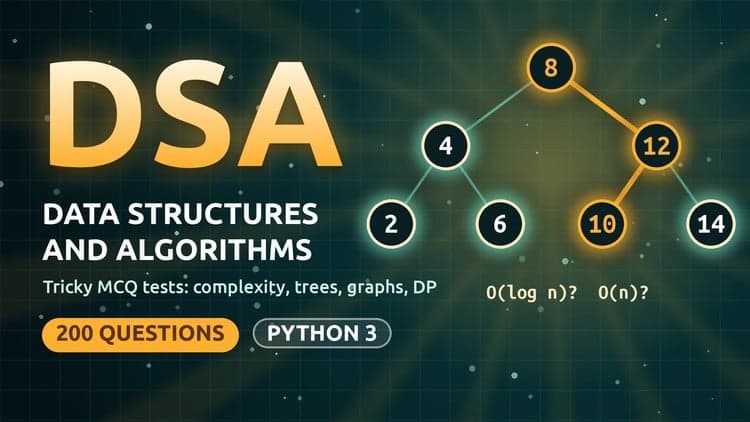
Data Structures and Algorithms: Tricky MCQ Practice Tests
Master new skills with expert-led instruction. Get 100% OFF with verified coupons and earn your certificate.
Lifetime access • Certificate included
This course includes:
- 📹0 mins on-demand video
- 📄0 articles
- 📥0 downloadable resources
- 📱Access on mobile and TV
- 🏆Certificate of completion
- ♾️Full lifetime access
📖About This Course
Test How Well You Really Know Data Structures and AlgorithmsMost interview mistakes are not about forgetting an algorithm. They come from details: a binary search that never stops, a sliding window whose left edge moves backwards, a heap that is not sorted, a memo key that forgets a parameter, a Dijkstra that trusts a negative edge, or a slice that quietly turns a linear loop into a quadratic one. These practice tests check whether you can spot those details before they cost you an interview or a production incident. What this practice test course offers:200 original multiple-choice questions in 4 practice tests of 50, grouped by topic Short Python 3 programs you must trace: what do they print, which exception do they raise, or do they ever finishComplexity questions that include the hidden costs of built-in operations such as slicing, in on a list, string concatenation and popping from the front of a listAn explanation for every answer option, plus an overall explanation of the rule behind itEvery program was run with Python 3, so every keyed answer matches what the interpreter really does Topics covered:Big O, Omega and Theta, recurrences, amortized versus average cost, and the real cost of Python built-insBinary search boundaries, bisect, binary search on the answer, two pointers, sliding windows and prefix sumsStacks, queues, deques, ring buffers, monotonic stacks and heaps with heapqHash tables, hashability, collisions, linear probing, linked lists, cycle detection and LRU cachesTrees, BST insertion, deletion and validation, AVL and red-black guarantees, tries, B-trees and Fenwick treesBFS, DFS, Dijkstra, Bellman-Ford, topological sort, union-find, minimum spanning trees and Floyd-WarshallRecursion, memoization, dynamic programming, backtracking and generatorsSorting stability and lower bounds, quicksort and merge sort details, greedy algorithms and bit manipulation Who should take this course?Developers preparing for coding interviews, online assessments or a data structures examPython programmers who want to know what their code really costsComputer science students who have finished a DSA course and want challenging practice questionsYou should already know basic Python syntax and the classic data structures. If you have never met a binary tree or a hash table, start with a data structures course and come back here to test yourself. How to use the tests: take one test at a time, then read every explanation, including the ones for questions you answered correctly. Retake a test a few days later to check that the rules have stuck.This course is independent and is not affiliated with or endorsed by the Python Software Foundation. Python is a registered trademark of the Python Software Foundation.
Frequently Asked Questions
Q: Is this course really free?
Yes! Using our verified coupon code, you can enroll for 100% OFF. No hidden charges.
Q: Do I get a certificate?
Upon completion of all video lectures, Udemy will issue a certificate of completion.
Q: How long is my access?
Once you enroll with the coupon, you get full lifetime access to the materials.
You May Also Like

AWS DynamoDB Mastery - Free Udemy Course [100% Off]

Professional Certificate in SQL and SQL for Data Analysis