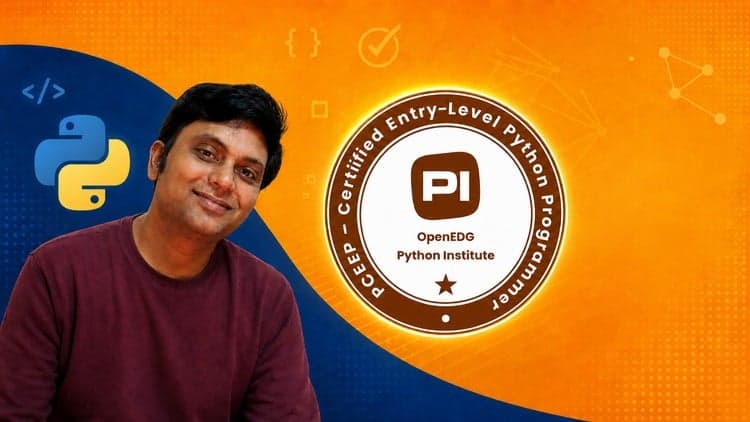
Python PCEP: Pass Certified Entry-Level Python Programmer
Master new skills with expert-led instruction. Get 100% OFF with verified coupons and earn your certificate.
Lifetime access • Certificate included
This course includes:
- 📹0 mins on-demand video
- 📄8 articles
- 📥0 downloadable resources
- 📱Access on mobile and TV
- 🏆Certificate of completion
- ♾️Full lifetime access
📖About This Course
The Python PCEP exam is conducted by the "python institute". This Python PCEP certification Course(Video-based course) will guide you to pass the Python PCEPexam on 1st attempt and once you practice all the examples in this course, you will easily pass the exam with at least 90% marks. There are more than 250 examples in this course that will serve you like Python PCEP Practice Tests. There are multiple PCEP quizzes to test your Knowledge. You can consider these quizzes as Python PCEP mock Tests. These PCEP mock exams or quizzes will give you enough idea about the actual exam.This course consists of 5 sections or modules that will teach you everything about PCEP and will help you to clear the PCEP - Certified Python Entry-Level Programmer exam(PCEP-30-01).The actual Python PCEP certification will have 30 questions as mentioned below -1. Module 1: Basic Concepts (5 questions)Basic conceptsInterpreter, compiler, lexis, semantics, syntax, Keywords, etc.Literal - Integer, Boolean, Floats, scientific notation, stringcommentprint()input()Other numeral systems - binary, decimal, octal, and hexadecimalAritmetic(numeric) operators -> +, -, *, /, //, %, **String Operators: +, *assignments and shortcut operators2. Module 2: Data Types, Evaluations, and Basic I/O Operations (6 Questions)operators: unary and binary, priorities and bindingbitwise operators: ~ & ^ | << >>Boolean operators: or, and, notBoolean expressionsrelational operators ( == != > >= < <= ), building complex Boolean expressionsaccuracy of floating-point numbersbasic i/o (input and output) operations using - input(), print(), int(), float(), str(), len() functionsformat print() output with end= and sep= argumentstype castingbasic calculationssimple strings: constructing(create), assigning, indexing, immutability3. Module 3: Control Flow – loops and conditional blocks (6 questions)conditional statements: if, if-else, if-elif, if-elif-elsemultiple conditional statements - multiple if statementthe pass instructionLoops: while, for, range(), inIteration - iterating through sequencesloops continued: while-else, for-elsenesting loops and conditional statementscontrolling loop execution: break, continue4. Module 4: Data Collections – Lists, Tuples, and Dictionaries (7 questions)simple lists: constructing vectors, indexing, and slicing, the len() functionlists in detail: indexing, slicing, basic methods (append(), insert(), index()) and functions (len(), sorted(), etc.), del instruction, iterating lists with the for loop, initializing, in and not in operators, list comprehension, the difference between copying and cloninglists in lists: matrices and cubestuples: indexing, slicing, building, immutabilitytuples vs. lists: similarities and differences, lists inside tuples and tuples inside listsdictionaries: building, indexing, adding and removing keys, iterating through dictionaries as well as their keys and values, checking key existence, keys(), items(), and values() methodsstrings in detail: escaping using the \ character, quotes, and apostrophes inside strings, multi-line strings, basic string functions.5. Module 5: Functions (6 questions)define and call(invoking) your own functions(user-defined functions) and generatorsreturn and yield keywords, returning results,the None keyword,recursionparameters vs. arguments,positional keyword and mixed argument passing,default parameter valuesconverting generator objects into lists using the list() functionname scopes, name hiding (shadowing), the global keywordPCEP Certification: Exam InformationExam Name: PCEP Certified Entry-Level Python ProgrammerExam Code: PCEP-30-01Exam Level: EntryPre-requisites: NoneDuration: 45 minutes (exam) + approx. 5 minutes (Non-Disclosure Agreement/Tutorial)Number of Questions: 30Format: Single-choice and multiple-choice questions, drag & drop, gap fill | Python 3. xPassing score: 70%Language: EnglishDelivery Channel: OpenEDG Testing ServicePCEP certification is a professional Entry-Level Python Programmer Exam to test a person’s ability to understand basic coding related to Fundamentals of Python Programming. The candidate will gain all the necessary knowledge of Python Programming, its syntax, semantics, and basic concepts like the below -Concepts like - literals, print(), input(), numbers, strings, etc.knowledge of operators - unary, binary, bitwise, boolean, relational operators, simple strings, data type, evaluation, I-O, etc.Control Flow - Loops, If, While, for, break, continue, passData collections - Lists, tuples, dictionaries, stringsFunctions - Arguments, Parameters, recursion, scope, global, positional arguments, Keyword arguments, None, yield, default parameter, etc.Other benefits of the PCEP courseThis course will also help you to build your Python Projects.The course will be of great help for students who want to clear Microsoft 98-381 exam for Python.This course will also test you if you are ready to start your reparation for PCAP.
Python PCEP: Free Udemy Course [100% Off] | Pass Certified Entry-Level Python Programmer
Limited-Time Offer: This IT Certifications Udemy course is now free with our exclusive 100% discount coupon code. Originally $89.99, enroll now at zero cost and gain lifetime access to professional Python training. Don’t miss this chance to master Python fundamentals without spending a dime!
What You’ll Learn in This Free Udemy Course
This comprehensive free online course on Udemy covers everything you need to become proficient in Python programming. Whether you’re a beginner or refining your skills, this free Udemy course with certificate provides hands-on training in foundational concepts.
- Master Python syntax to build a career-ready skillset
- Learn loops, conditionals, and data structures for real-world problem-solving
- Practice 250+ examples as Python PCEP practice tests
- Dominate PCEP-30-01 exam topics with 50+ quizzes
- Gain practical Python skills for jobs and freelancing
- Understand tuples, dictionaries, and strings for advanced coding
- Earn a certificate to boost your LinkedIn and resume
Who Should Enroll in This Free Udemy Course?
This free certification course is ideal for aspiring developers, students, or professionals seeking affordable upskilling. Here’s who will benefit most:
- Entry-level learners starting their coding journey
- Career changers entering the tech industry
- Students preparing for Microsoft 98-381 exam
- Freelancers needing Python basics for client projects
- Self-taught coders upgrading skills
- Recent graduates filling resume gaps
Meet Your Instructor
Learn from Sandeep Kumar, an experienced Python instructor with a proven track record of teaching thousands of students. His engaging teaching style simplifies complex topics, ensuring you master even challenging PCEP concepts quickly.
Course Details & What Makes This Free Udemy Course Special
With a 4.5+ rating and 9,288 students already enrolled, this Udemy free course offers:
[article_count] comprehensive lessons in English[unique value proposition based on course content and benefits]. Plus, with mobile access, you can learn anytime, anywhere—perfect for busy professionals. Upon completion, you’ll receive a certificate to showcase on LinkedIn and your resume. This IT Certifications course in the IT Software niche includes lifetime access, so revisit materials whenever you need a refresher.
How to Get This Udemy Course for Free (100% Off)
Follow these steps to claim your free enrollment:
- Click the enrollment link to visit the Udemy course page
- Apply coupon code: JULY-2026 at checkout
- The price will drop from $89.99 to $0.00 (100% discount)
- Complete your free enrollment before [No expiration date specified]
- Start learning immediately with lifetime access
⚠️ Important: This free Udemy coupon code is available indefinitely. Enroll now while it’s free—no credit card required, no hidden fees, no trial periods. Once enrolled, the course is yours forever.
Why You Should Grab This Free Udemy Course Today
Here’s why this free certification course is an opportunity you can’t afford to miss:
1. Learn at zero cost with no obligations—perfect for budget-conscious learners.
2. Skills like Python loops and data structures open doors to $70K+ entry-level jobs.
3. A free certificate adds instant credibility to your resume.
4. Lifetime access ensures future skill refreshers at no extra cost.
5. Mobile compatibility lets you code on-the-go—ideal for busy schedules.
Frequently Asked Questions
Is this Udemy course really 100% free?
Yes! Apply coupon code JULY-2026 for 100% off. No payment required, no trial period.
How long do I have to enroll?
This offer is available indefinitely. Enroll now to keep lifetime access forever.
Will I get a certificate?
Absolutely! Complete the course to download your Udemy certificate.
Can I use the mobile app?
Yes! Access via Udemy’s iOS or Android app.
How long do I have access?
Lifetime access after free enrollment. No time limits.
Frequently Asked Questions
Q: Is this course really free?
Yes! Using our verified coupon code, you can enroll for 100% OFF. No hidden charges.
Q: Do I get a certificate?
Upon completion of all video lectures, Udemy will issue a certificate of completion.
Q: How long is my access?
Once you enroll with the coupon, you get full lifetime access to the materials.
You May Also Like
Claude Certified Associate Foundations CCAO-F Practice Exams
ISO 27001:2022 Foundation: preparación para el examen