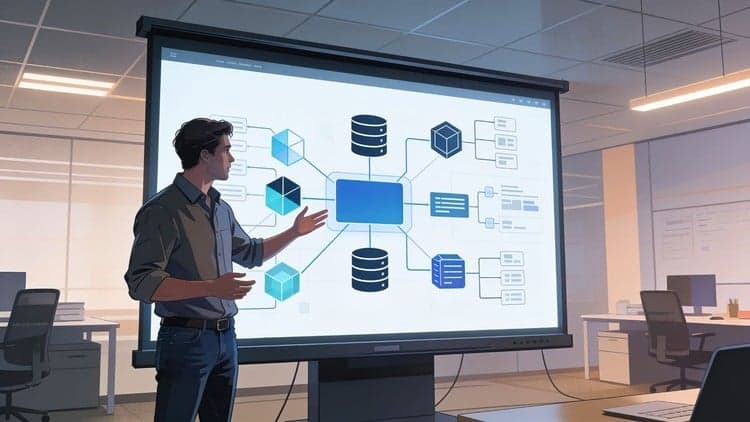
Software Architecture and System Design for SaaS & AI Agent
Master new skills with expert-led instruction. Get 100% OFF with verified coupons and earn your certificate.
Lifetime access • Certificate included
This course includes:
- 📹0 mins on-demand video
- 📄3 articles
- 📥0 downloadable resources
- 📱Access on mobile and TV
- 🏆Certificate of completion
- ♾️Full lifetime access
📖About This Course
This course contains the use of artificial intelligenceDisclosure: AI tools were used only to assist in creating the course outline and course thumbnail. All instructional content, explanations, and project walkthroughs were fully created manually by the instructor.Welcome to Software Architecture and System Design for SaaS & AI Agent course. This is a comprehensive project based course where you will learn how to design software architecture and implement system design principles to SaaS, mobile apps, and AI agents. This course is a perfect combination between software architecture and system design, making it an ideal opportunity to practice your system design skills while improving your technical knowledge in software engineering. In the introduction session, you will learn the basic fundamentals of software architecture and system design, such as getting to know about functional and non functional requirements, and you will also learn about software architecture trade off. Then, in the next section, we will learn about the difference between monolithic and microservices architecture, specifically, we will learn how these architectures are structured, how their components communicate, and when to use each architecture based on the requirements of the application. Afterward, we will learn about API architecture and service communication. This section will cover API design, communication between services, synchronous and asynchronous communication, and how different components exchange data in a software system. Following that, we will also learn about Database Architecture for SaaS Applications, we will design databases for SaaS applications, choose suitable database structures, and manage data efficiently as the application grows. Then, after that, we will learn about Multi Tenant SaaS Architecture where we will learn how to design applications that can securely support multiple customers or organizations while efficiently sharing system resources and data. We will also learn about distributed systems and event driven architecture. This section will cover how large applications are divided into independent components, how events trigger actions across different parts of a system, and how these architectures can help applications handle growing workloads and improve reliability. Additionally, we will learn about File Storage and Media Processing Architecture, we will understand how applications store and manage large files, process images and videos, and deliver media efficiently to users. Once we are done with software architecture, we will move on to system design. Firstly, we will learn about load balancing and horizontal scaling, where we will distribute traffic across multiple servers using NGINX and test how the system handles increasing traffic. Then, after that, we are going to learn about capacity planning, specifically we will calculate Queries Per Second, Daily Active Users, concurrent users, storage, and bandwidth to estimate the resources required to support growing workloads. After learning about system design concepts, we are going to work on two case studies. The first one is a food delivery app while the second one is a video streaming platform, where we will estimate traffic, bandwidth, and infrastructure requirements. Once we are done with system design, we will move on to agentic AI architecture. Firstly, we are going to learn about AI agent architecture and multi agent architecture, this section will cover the key components of AI agents, how agents make decisions and use external tools, and how multiple specialized agents can work together to complete complex tasks. After that, we are going to build AI legal research agent and implement ReAct loop. This project will enable us to understand how an AI agent can reason, take actions, observe results, and decide what to do next autonomously. Following that, we are going to build AI tech support assistant that uses memory management, RAG, and vector database. Lastly, at the end of the course, we are going to implement humans in the loop, which will enable us to keep humans involved in reviewing and approving important AI agent decisions and actions.First of all, before getting into the course, we need to ask these questions to ourselves, why should we learn about software architecture and system design? Well, here is my answer, no matter how good your software development skills are, you still need to understand how to structure and design a software system effectively. For example, you may know how to build individual features, but you also need to know how those features should be organized and how the system should handle increasing users.Below are things that you can expect to learn from this course:Learn the basic fundamentals of software architecture and system designLearn about functional, non functional requirements, and software architecture trade offLearn about monolithic architecture and microservices architectureLearn about API architecture, synchronous, and asynchronous communicationLearn about database architecture and database selectionLearn about multi tenant SaaS architecture and data isolation conceptsLearn about distributed system and event driven architectureLearn about file storage and media processing architectureLearn how to conduct load balancing and horizontal scaling simulation using NGINXLearn about capacity planning in system designLearn about food delivery app system designLearn about video streaming platform system designLearn about AI agent architecture, LLM and external API integrationLearn about multi agent system architecture and orchestrationLearn how to build AI legal research agent and implement ReAct loopLearn how to build AI tech support agent and integrate memory management, RAG, and vector databaseLearn about human in the loop and reinforcement learning from human feedback
Frequently Asked Questions
Q: Is this course really free?
Yes! Using our verified coupon code, you can enroll for 100% OFF. No hidden charges.
Q: Do I get a certificate?
Upon completion of all video lectures, Udemy will issue a certificate of completion.
Q: How long is my access?
Once you enroll with the coupon, you get full lifetime access to the materials.
You May Also Like

SC-100 Microsoft Cybersecurity Architect Exam Practice Tests
ISO/IEC 20000 Lead Auditor Practice Exams: ITSMS